Tag: spirit

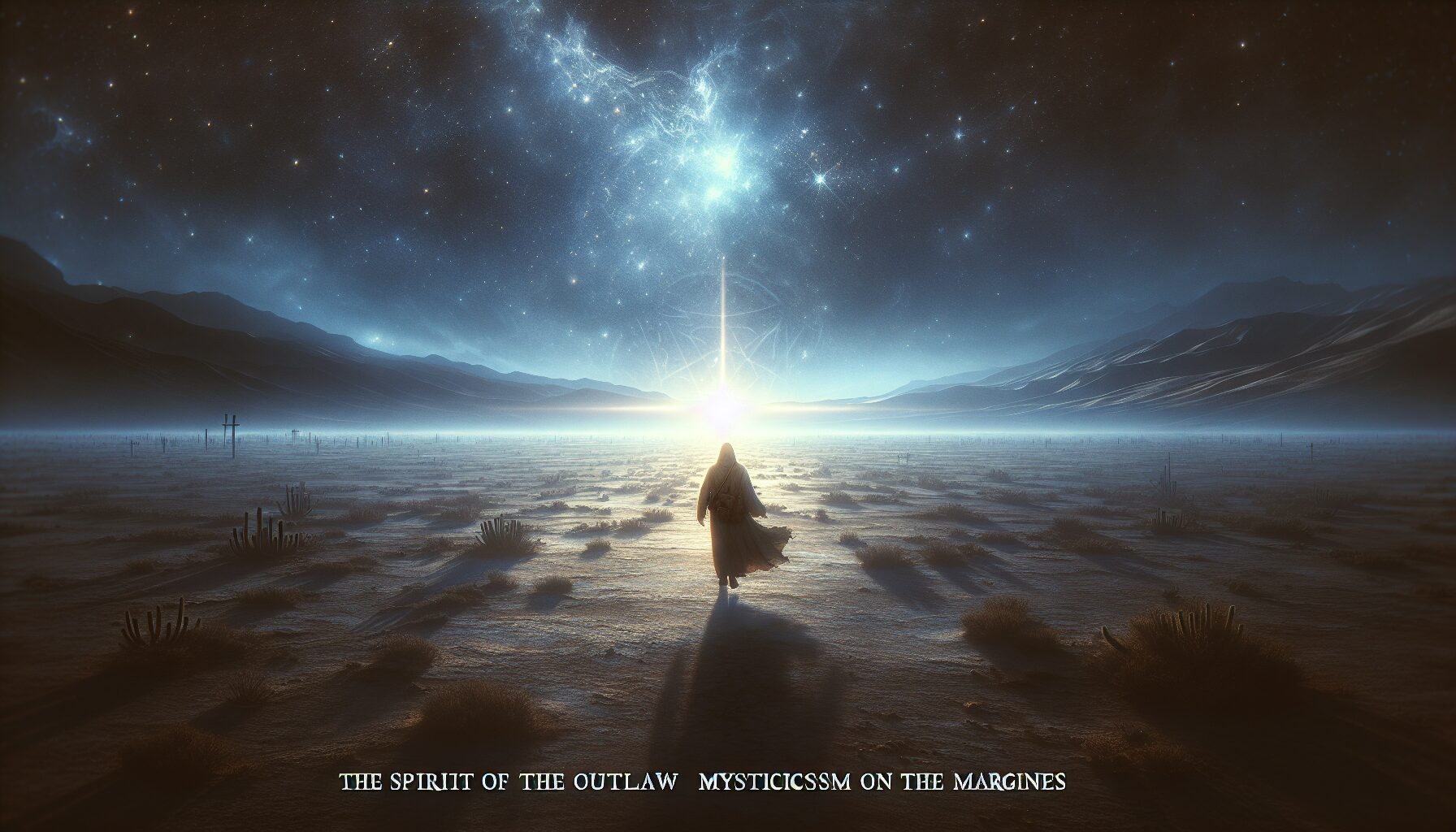
  • The Spirit of the Outlaw – Mysticism on the Margins

    The Spirit of the Outlaw – Mysticism on the Margins

    The Spirit of the Outlaw – Mysticism on the Margins

    The Spirit of the Outlaw: Mysticism on the Margins

    Throughout history, the figure of the outlaw has captivated the human imagination, serving as both a symbol of rebellion and an enduring archetype of freedom. These marginalized figures, often living outside the bounds of law and society, evoke a sense of mysticism rooted in their defiance and unyielding spirit. This exploration of the outlaw encapsulates not just their actions, but the rich tapestry of myths and legends that surround them.

    The Allure of the Outlaw

    Outlaws are romanticized for their audacity and independence. They emerge in stories worldwide, embodying the tension between freedom and authority. From Robin Hood in England to Pancho Villa in Mexico, outlaws are celebrated as proponents of justice—albeit through unconventional means. This dichotomy between law and morality often endows these figures with a mystical, almost spiritual role.

    “The life of a legendary outlaw is a mirror to society’s insecurities and ideologies, amplifying the virtues and vices of an era.”

    As noted on History, the outlaw’s journey reflects broader societal questions and contradictions. They become metaphors for truths that are uncomfortable or hard to confront directly.

    Mysticism and Myth

    Many cultures have infused their outlaw tales with elements of mysticism. In doing so, they transform these real-life rebels into larger-than-life figures, blurring the lines between human and myth. These narratives elevate outlaws from mere criminals to enigmatic heroes capable of miraculous feats.

    • Robin Hood: Known for ‘robbing from the rich and giving to the poor’, the legend of Robin Hood includes miraculous escapes and an unwavering moral code, painting him as a folk hero rather than a common thief.
    • Yokai and Ninjas in Japan: Many Japanese myths include outlaw figures with almost supernatural abilities. The blurred lines between history and folklore serve to mystify figures who acted against the societal norms of the time.
    • Pancho Villa: As a revolutionary leader, Pancho Villa’s exploits are celebrated in song and story, highlighting his strategic genius and almost prophetic vision for Mexico.

    Rebellion and Redemption

    The outlaw’s spirit also embodies themes of redemption and rebellion. Their narratives are imbued with the hope that change is possible, even for those cast out by society. Mysticism often enters these stories as a vehicle for transformation and rebirth.

    Religious and spiritual elements often underscore these journeys. For instance, many outlaws in folklore claim divine justification for their actions. This intersection of spirituality and rebellion echoes the inherent human quest for meaning, justice, and truth.

    The Modern Outlaw

    In contemporary society, the spirit of the outlaw lives on through various subcultures and countercultures. Modern-day ‘outlaws’, from hackers who challenge digital boundaries to activists fighting for systemic change, continue to push against the constraints of the status quo.

    “Today’s outlaws navigate a digital frontier, challenging the status quo in ways that speak to an evolving understanding of justice and equality.”

    The Guardian notes that these digital frontiers are not just battlegrounds for technology, but for ideologies as well—embodying the essence of the mystical rebel spirit in today’s era.

    The Enduring Legacy

    The persistent allure of the outlaw speaks to a universal human longing for freedom and justice. Rooted in real-world defiance and revived through mythology, these figures remind us of the transformative power of rebellion. The mysticism surrounding them is less about magic and more about what they represent: the unyielding force of a spirit unwilling to succumb to injustice or conformity.

    The narrative of the outlaw persists because it resonates deeply within the human psyche, urging us to question the boundaries enforced by society and to consider the potential that resides within each act of rebellion, not only as a personal journey but also as a grand, mystical assertion. Thus, the spirit of the outlaw remains both a provocative symbol and an inspiring call to action for those on the margins seeking to change the world.

  • Salt in the Spirit – Why Outcasts Often Become the Deepest Seekers

    Salt in the Spirit – Why Outcasts Often Become the Deepest Seekers

    Salt in the Spirit: Why Outcasts Often Become the Deepest Seekers

    The journey of self-discovery and spiritual seeking often finds its roots in the most unlikely of places. History and literature have long celebrated the pilgrimage of the outcast, suggesting that those who exist on the fringes of society tend to embark on a profound quest for meaning. But why is this the case? Why do the marginalized and isolated often become the deepest seekers?

    The Call of the Unseen

    Outcasts, by the nature of their exclusion, often develop a heightened sense of introspection. As social scientist Brené Brown notes, “Connection is why we’re here. We are hardwired to connect with others, it’s what gives purpose and meaning to our lives” (HuffPost). When deprived of these connections, many turn inwards, seeking the solace and understanding they cannot find externally.

    In this internal landscape, the search for spiritual truth and personal meaning becomes a refuge. Seclusion, whether self-imposed or circumstantial, provides the quiet necessary for deep reflection and the exploration of one’s spiritual path.

    A Journey Born from Pain

    Pain has long been a catalyst for transformation. The great spiritual teacher Eckhart Tolle explains, “The primary cause of unhappiness is never the situation but your thoughts about it” (Eckhart Tolle). This insight into pain becomes a guiding light for many who feel the sting of rejection and isolation.

    “The wound is the place where the Light enters you.” – Rumi

    For outcasts, pain is often a constant companion, yet it is this very pain that encourages a reevaluation of life’s deeper truths. Through suffering, outcasts are uniquely positioned to question the status quo of societal norms and values, seeking instead a spiritual grounding that brings peace amidst turmoil.

    Embracing the Role of the Wanderer

    Throughout history, wanderers and pilgrims have left behind the comforts of their known world in search of higher truths. Outcasts naturally adopt this role, not necessarily by choice but by circumstance. Whether it’s the desert fathers who fled to the wilderness or the sages of ancient East who sought enlightenment through solitude, the notion of separation from society to find spiritual clarity is a recurring theme in spirituality.

    • Siddhartha Gautama: Before becoming the Buddha, Siddhartha left a life of luxury to seek enlightenment through self-imposed exile and meditation.
    • Saint Francis of Assisi: After a dramatic conversion, he embraced a life of poverty and exclusion, founding a spiritual movement.
    • Emily Dickinson: The reclusive poet who transformed her solitary life into a rich tapestry of poetry exploring themes of spirituality and existence.

    In each of these cases, the struggle faced by these individuals outside the bounds of societal norms acted as the crucible for their spiritual insights.

    Rejection as a Form of Freedom

    Paradoxically, the rejection that defines an outcast can also free them from societal expectations, allowing space for authentic spiritual exploration. The lack of societal constraints can break down imposed narratives, offering a blank canvas upon which to craft a personal and unique path to spiritual awakening.

    Thomas Merton, a Trappist monk and author, eloquently stated, “The greatest need of our time is to clean out the enormous mass of mental and emotional rubbish that clutters our minds” (Thomas Merton Center). Outcasts often engage in this decluttering, freed from conventional paths and open to novel experiences and thoughts.

    Navigating Inner and Outer Realms

    The spiritual path is not solely an internal journey. It involves navigating both inner realms and the external world. By living on society’s edge, an outcast perceptively walks between these worlds, often seeing truths hidden from those ensconced in societal comfort.

    In embracing their status, outcasts can become conduits for renewal, knowers of paths not taken, and witnesses to the resilience of the human spirit. As spiritual seekers, they possess a unique viewpoint that can shed light on both personal and collective spirituality.

    Conclusion

    The journey of the outcast from the margins to the center of spiritual discovery showcases the transformative power of solitude, pain, and societal rejection. These factors combine to form a fertile ground for profound spiritual inquiry. As seekers of deeper truth, outcasts embody the spirit of exploration and transformation, highlighting that often the most profound awakenings occur in those who start from seemingly humble beginnings.

  • The Codification of Spirit — When living truth is embalmed in rules

    The Codification of Spirit — When living truth is embalmed in rules

    In the early days of any movement, energy flows freely. Ideas explode like fireworks, unrestrained by the confines that inevitably follow. But as time marches on, the initial spark is often codified, condensed into rules and regulations meant to preserve the essence of the original vitality. This transition, while seemingly beneficial for structure and preservation, can sometimes stifle the very spirit it aims to capture.

    The Birth of Codification

    Codification is not a new phenomenon. From the Codex Hammurabi to modern constitutions, humans have always sought to enshrine beliefs and practices in text. This process can be seen as both a celebration of human intellectual achievement and a recognition of mortality. The paradox lies in that even as we seek to immortalize living truth through codification, we risk embalming it—trapping it in amber where it cannot change or grow.

    Consider the words of C.S. Lewis, who observed, “The perfect church service would be one we were almost unaware of; our attention would have been on God.” The deeper truth in his reflection speaks to the heart of the spirit behind rituals and rules: that when our focus is on the mechanism rather than the essence, the life within can slip away unnoticed.

    When Rules Become Binding

    The story of the codification of spirit is vividly illustrated in the realm of religious traditions. Religions, at their inception, are often radical and transformative. They seek to upend the status quo, offering new perspectives and paths. However, as they grow, the necessity of organizing believers into a coherent community leads to the creation of doctrines and codes. These rules provide guidance and shared identity, yet they risk becoming a hierarchy that can extinguish innovation.

    • Unity vs. Uniformity: Codification aims for unity but often results in uniformity, where deviation from the norm is less tolerated.
    • Preservation vs. Growth: By focusing on preserving the original teachings, there is little room left for new interpretations or growth.
    • Control vs. Freedom: Rules provide order, but they can also restrict the freedom that gave rise to the original movement.

    This phenomenon is not confined to religion alone. Movements in science, art, and societal change have encountered similar fates. The initial breakthrough or rebellion gradually morphs into an established system, often losing the daring spirit in exchange for longevity and legitimacy.

    Finding Balance in Codification

    The challenge lies in finding balance, recognizing that while rules are necessary, they should not become prison bars. Dynamic movements, whether philosophical or cultural, must embrace change and renew their spirit to avoid stagnation. Jazz music, for instance, thrives on its organic and improvisational roots even as it respects certain foundational tenets.

    “The only true wisdom is in knowing you know nothing.” — Socrates

    This famous quote by Socrates reflects the essence of retaining an open mind. It suggests accepting impermanence and being perpetually open to learning and growth, an approach all too often sacrificed on the altar of certainty and codification.

    The Path Forward

    So how does one preserve the living truth without suffocating it in rules? The key might be in fostering environments that allow for continual questioning and creativity. Here are ways to maintain the spirit within organizational frameworks:

    • Encourage Dialogue: Maintain open forums for discussion, where ideas can evolve without fear of censure.
    • Adaptability: Establish rules as guidelines that can be revised, recognizing that societal and cultural contexts change over time.
    • Foster Innovation: Support innovators within the movement to experiment and explore new dimensions of understanding.

    The codification of spirit need not be a death sentence for dynamism. When approached with humility and openness, it can serve as a foundation for further exploration rather than the ceiling that limits it. As we navigate the tension between rules and spirit, let us strive for systems that honor both the past and the potential of the future.