Tag: souls

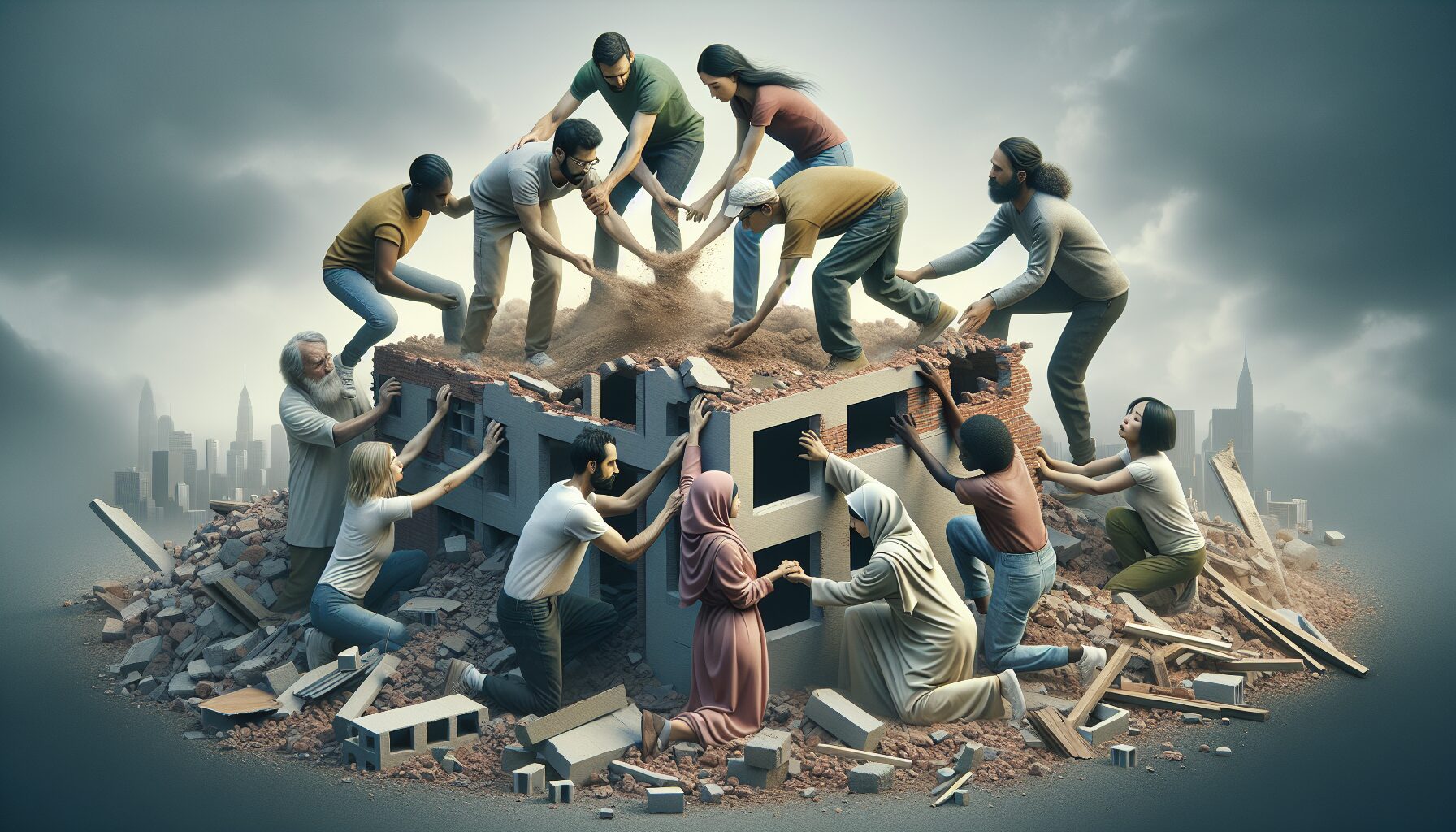
  • After the Collapse – What Persecuted Souls Build Next

    After the Collapse – What Persecuted Souls Build Next

    After the Collapse: What Persecuted Souls Build Next

    The echoes of calamity have often paved the path to remarkable rebirths in human history. In the wake of societal collapse, where devastation and despair might be expected to blanket the earth, resilient souls steadily reconstruct their world. These individuals, often those previously marginalized and persecuted, emerge not only to rebuild but to innovate, driving forward change and development previously deemed unimaginable.

    The aftermath of a collapse strips away the facades of civilization, providing a blank canvas upon which new, often more equitable societies can be painted. As noted by renowned historian Yuval Noah Harari, “Evolution molded us to live in small bands of no more than a few dozen individuals.”

    “What unifies human communities, especially after a collapse,” says Harari, “is our ability to create shared myths and narratives that bind us together.”

    The post-collapse society often embraces communal sharing and participatory governance structures. This shift can be seen vividly in historical examples where centralized, oppressive regimes have fallen, catalyzing grassroots movements that value collective wellbeing over individual gain.

    Rebuilding from the Roots: Success Stories

    During these times, technology and tradition frequently intertwine to form the foundation of future societies. In Rwanda following the 1994 genocide, a country once on the brink of failure transformed into one of Africa’s leading digital powerhouses. Their journey illustrates how resilience and innovation can lay the groundwork for recovery and growth.

    • Community Initiatives: Local initiatives become crucial, fostering a sense of ownership and belonging among residents.
    • Technological Advancements: As seen in Krakauer’s “Endurance”, technology adopted by a unified group can lead to revitalization. Communities often reach back to simpler, more sustainable living while embracing innovative technologies at a rapid pace.
    • Mutual Aid: In the rubble of traditional economic systems, barter systems and mutual aid networks arise, providing immediate relief and fostering long-term sustainability.

    Such transformations are not simply organic; they require the strength and determination of those who persist through adversity. As Rebecca Solnit eloquently puts it in her book A Paradise Built in Hell, “In the aftermath of disaster, people are often their most courageous.”

    The worlds these persecuted souls build next are diverse etchings of hope and resolve, honoring past struggles while crafting fertile grounds for future generations. For more insights into post-collapse societies and their challenges, visit The Guardian for an exploration of humanity’s ability to adapt and overcome.

    The essence of humanity’s capacity to rebuild lies not just in survival, but in the spirit of innovation that leads to a more inclusive and resilient society.

  • The Final Straw — The soul’s quiet breaking point

    The Final Straw — The soul’s quiet breaking point

    The expression “the straw that broke the camel’s back” is a well-worn metaphor used to describe that moment when something small and seemingly insignificant becomes the catalyst for a larger, profound reaction. This phrase, however, does more than just capture a single aspect of human experience—it embodies the cumulative nature of stress and burden that eventually leads to the soul’s breaking point.

    The soul, in its vast complexity, can handle much adversity and challenge. It is resilient, tough, and adaptable. However, there comes a moment when the pressure, no matter how small the final push, becomes unbearable. This is the final straw—the soul’s quiet breaking point. This article explores the nuanced and often imperceptible journey to this profound moment.

    The Nature of Accumulation

    Every day, we navigate through stressors both big and small—work deadlines, family obligations, societal pressures, and personal expectations. Each adds a weight to our being, often unnoticed until it becomes too much. The human soul can absorb an incredible amount of strain, adapting and soldiering on. However, as Anne Lamott poignantly noted, “Almost everything will work again if you unplug it for a few minutes, including you.”

    • Resilience Unrecognized: We often fail to recognize our own resilience. The soul withstands much turmoil thanks to its innate strength, but not indefinitely.
    • Transcending Tolerance: While humans are adept at managing stress, there is always a threshold beyond which they are unable to cope.

    The Straw that Broke the Camel’s Back

    The ‘final straw’ is often deceptive in its insignificance. It is rarely a catastrophic event but rather something minor—a forgotten errand, a sideways glance, or a harsh word. These are the moments that, when combined with the mounting pressures of life, result in a profound emotional eruption.

    “Most of the important things in the world have been accomplished by people who have kept on trying when there seemed to be no hope at all.” — Dale Carnegie

    While long-suffering perseverance is admirable, it is also imperative to understand and listen to the signs of impending breakdowns before they reach a destructive crescendo.

    Signs of Impending Breakdown

    The subtle signals that herald an approaching breaking point are as varied as they are numerous. Recognizing these signs is crucial to preventing a descent into overwhelm.

    • Physical Symptoms: Chronic fatigue, sleep disturbances, and tension headaches are common physical indicators.
    • Emotional Outbursts: Disproportionate emotional reactions, such as sudden weeping or unexplained irritability.
    • Cognitive Impairment: Decreased concentration, memory lapses, and decision-making difficulties.

    Recognizing these signs is not only beneficial for self-care but also for offering support to others who might be laboring silently under their burdens.

    The Aftermath: What Happens When the Break Occurs

    When the soul reaches its quiet breaking point, the aftermath is profound. Some experience a sense of liberation—an emotional catharsis that, while initially painful, eventually leads to healing and renewal. For others, however, this breaking point can signify a deeper descent into despair and depression.

    Therapist and author Julia Cameron emphasized the healing power of creativity in navigating through such emotional turmoil, suggesting that “We are, ourselves, creations. And we, in turn, are meant to continue creativity by being creative ourselves.”

    • Transformation: Many individuals find solace in transformative activities like writing, painting, or gardening, as these help rebuild emotional resilience.
    • Seeking Support: Professional help, whether through counseling or support groups, becomes imperative for many in finding a new equilibrium.

    Strategies for Reinforcement

    Preventing the soul from reaching its final breaking point involves proactive measures that cultivate resilience and reinforce emotional defenses. Here are several strategies to consider:

    • Mindfulness Practices: Incorporating mindfulness and meditation into daily routines can significantly reduce stress levels and improve emotional well-being.
    • Connectedness: Building and maintaining strong social connections can provide crucial support during times of difficulty.
    • Regular Reflection: Consistent introspection facilitates self-awareness and helps in recognizing when intervention is necessary.

    A final word on resilience comes from the poignant wisdom of Viktor E. Frankl, the illustrious psychologist and Holocaust survivor, who wrote in “Man’s Search for Meaning,” “When we are no longer able to change a situation, we are challenged to change ourselves.”

    A Collective Responsibility

    Beyond individual efforts, there is a collective responsibility in recognizing and responding to the signs of someone nearing their emotional brink. Whether it’s through workplace policies that stress mental health awareness or educational programs that teach emotional intelligence from an early age, society must embrace a more empathetic approach.

    Therefore, the imperative is not only to guard our own souls against reaching a breaking point but to foster environments where others feel safe and supported in expressing their vulnerabilities. This way, we collectively prevent that final, quiet breaking point from being reached.

    Ultimately, understanding and addressing the final straw—the soul’s quiet breaking point—requires both self-awareness and communal care. By doing so, we not only fortify ourselves but uplift the human experience, creating a world where everyone can thrive without fear of breaking under the weight of life.

  • The Unseen Victims — Souls displaced by spiritual structure

    The Unseen Victims — Souls Displaced by Spiritual Structure

    The Unseen Victims — Souls Displaced by Spiritual Structure

    In the labyrinth of spiritual dimensions, where human beliefs conflate with divine convictions, a cadre of silent runners emerge: the unseen victims. These are the souls displaced by a rigorous spiritual structure that often fails to embrace the varyingly intricate mosaic of human experience.

    “Spirituality does not come from religion. It comes from our soul.”
    Anthony Douglas Williams

    The Doctrine of Displacement

    When viewing spirituality through an institutional lens, the displacement arises from a misalignment with personal journeys. Religious and spiritual doctrines, while serving as a compass for many, can inadvertently act as straitjackets for those whose paths meander beyond conventional boundaries. These individuals often find themselves cast adrift, yearning for solace yet caught between the crevices of dogma.

    The Architecture of Spiritual Structures

    Religious institutions have historically played pivotal roles in shaping societies, constructing grand architectures—both literal and ideological—that guide billions. However, these structures come with inherent limitations. As Psychology Today reported, an over-reliance on rigid structures can sometimes impede personal spiritual growth.

    • Formal Doctrines: Many spiritual paths are built upon formal doctrines that dictate beliefs and practices. While providing guidance, these can stiffen into inflexibility, leaving those who question or deviate feeling isolated.
    • Moral Absolutism: Fundamentally, absolutist views can clash with modern interpretations of morality and ethics, thereby displacing those who seek a more relativistic approach.
    • Ritualistic Obligations: Rituals, central to many spiritual structures, may lose their inherent meaning over time, becoming mere obligations rather than profound practices.

    Intersecting Journeys: Strangers Within Tradition

    Consider the early dissenters within established religions—figures like Martin Luther, or contemporary seekers who take leave of conventional paths to forge their own spiritual corridors. Such individuals often face stigmatization, regarded as heretics or outcasts despite being beacons of reform and rejuvenation. Their journeys exemplify the friction between steadfast institutions and evolving personal faith.

    “A hero is someone who has given his or her life to something bigger than oneself.”
    Joseph Campbell

    Rebels and Reformers

    These spiritual rebels, by choice or consequence, pave new roads, symbolizing hope for many who feel trapped. Their stories resonate with silent seekers disheartened by the enormity of spiritual edifice towering over personal enlightenment.

    For example, consider the rise of the “nones”—those who identify with no particular religion yet seek a deeper spiritual connection. The Pew Research Center has documented this shift, noting an increasing number of individuals disconnecting from traditional religious structures to embrace an autonomous quest for meaning.

    Rekindling the Spiritual Flame: The Search for Personal Sovereignty

    Humanity’s inherent need for soulful exploration demands a dynamic, capacious spiritual framework—one that acknowledges the sanctity of individual experience while also drawing from the collective wellspring of wisdom.

    Moving Beyond Structure

    Addressing the alienation induced by traditional structures requires a conscious infusion of adaptability and empathy into spiritual institutions. Efforts to understand diverse spiritual expressions highlight the importance of embracing pluralism and inclusiveness.

    • Interfaith Dialogues: Bridging divides by fostering conversations between different spiritual paths encourages mutual respect and deeper understanding.
    • Syncretic Practices: Incorporating elements from different traditions to create a holistic spiritual experience broadens avenues for personal exploration.
    • Inner Retreats: Encouraging individual retreats within one’s spiritual journey offers a sacred space for reflection and personal growth.

    Embracing the Spiritually Displaced

    Ultimately, acknowledging the souls displaced by spiritual structures means recognizing their unique narratives as vital threads in the tapestry of universal being. This acknowledgment invites an evolution of spiritual frameworks that emphasize personal integrity and inner freedom over systemic conformity.

    “The privilege of a lifetime is to become who you truly are.”
    Carl Jung

    The challenge—and opportunity—lies in fostering a spiritual environment that transcends rigid doctrines, inviting an enlightened discourse that honors the unseen victims as integral contributors to the spiritual ecosystem. Their stories, challenges, and triumphs offer profound insights into the multifaceted nature of human spirituality, reminding us of the perpetual dance between the seen and unseen, the established and the evolving.

    In celebrating these varied spiritual experiences, we embark on a collective journey toward redefining what it means to be spiritually whole, transforming the spiritual landscape into one that truly embraces every soul’s desire for connection, belonging, and transcendence.