Tag: what

  • After the Collapse – What Persecuted Souls Build Next

    After the Collapse – What Persecuted Souls Build Next

    After the Collapse: What Persecuted Souls Build Next

    The echoes of calamity have often paved the path to remarkable rebirths in human history. In the wake of societal collapse, where devastation and despair might be expected to blanket the earth, resilient souls steadily reconstruct their world. These individuals, often those previously marginalized and persecuted, emerge not only to rebuild but to innovate, driving forward change and development previously deemed unimaginable.

    The aftermath of a collapse strips away the facades of civilization, providing a blank canvas upon which new, often more equitable societies can be painted. As noted by renowned historian Yuval Noah Harari, “Evolution molded us to live in small bands of no more than a few dozen individuals.”

    “What unifies human communities, especially after a collapse,” says Harari, “is our ability to create shared myths and narratives that bind us together.”

    The post-collapse society often embraces communal sharing and participatory governance structures. This shift can be seen vividly in historical examples where centralized, oppressive regimes have fallen, catalyzing grassroots movements that value collective wellbeing over individual gain.

    Rebuilding from the Roots: Success Stories

    During these times, technology and tradition frequently intertwine to form the foundation of future societies. In Rwanda following the 1994 genocide, a country once on the brink of failure transformed into one of Africa’s leading digital powerhouses. Their journey illustrates how resilience and innovation can lay the groundwork for recovery and growth.

    • Community Initiatives: Local initiatives become crucial, fostering a sense of ownership and belonging among residents.
    • Technological Advancements: As seen in Krakauer’s “Endurance”, technology adopted by a unified group can lead to revitalization. Communities often reach back to simpler, more sustainable living while embracing innovative technologies at a rapid pace.
    • Mutual Aid: In the rubble of traditional economic systems, barter systems and mutual aid networks arise, providing immediate relief and fostering long-term sustainability.

    Such transformations are not simply organic; they require the strength and determination of those who persist through adversity. As Rebecca Solnit eloquently puts it in her book A Paradise Built in Hell, “In the aftermath of disaster, people are often their most courageous.”

    The worlds these persecuted souls build next are diverse etchings of hope and resolve, honoring past struggles while crafting fertile grounds for future generations. For more insights into post-collapse societies and their challenges, visit The Guardian for an exploration of humanity’s ability to adapt and overcome.

    The essence of humanity’s capacity to rebuild lies not just in survival, but in the spirit of innovation that leads to a more inclusive and resilient society.

  • The Loyalty Trap – Why Leaving Feels Impossible

    The Loyalty Trap – Why Leaving Feels Impossible

    Loyalty is often heralded as a virtue, embodying faithfulness and allegiance in personal and professional relationships. However, in many situations, loyalty can feel less like a virtue and more like a trap, making leaving an unrewarding job, a demanding friendship, or an unfulfilling relationship seemingly impossible. But why do people feel stuck, and what are the psychological underpinnings that bind them?

    The Emotional Investment

    Our deep-seated need for loyalty stems from emotional investment. Over time, we accumulate shared experiences, memories, and a sense of belonging that binds us to people and places. This emotional currency is often hard to relinquish.

    • Personal Identity: Our relationships, workplaces, and communities contribute significantly to our sense of identity. Leaving can feel like losing a part of oneself, which is why many choose to stay despite discomfort.
    • Fear of Regret: Psychologically, the fear of making the wrong decision and regretting it later is a powerful deterrent. The potential “what if” scenarios often overshadow the present dissatisfaction.

    The Sunk Cost Fallacy

    The sunk cost fallacy is a critical concept that explains much of why people remain in detrimental situations. This fallacy hinges on the misconception that we must continue investing time, money, or effort simply because we’ve already invested so much.

    “When people commit the sunk cost fallacy, they do things they shouldn’t, simply because they don’t want to waste the time or money they’ve already spent.” — Psychology Today

    Being aware of this cognitive bias doesn’t necessarily make individuals immune to it. The illusion of the wasted past effort often looms larger than prospective gain, perpetuating the cycle of entrapment.

    Societal and Cultural Pressures

    Loyalty is celebrated across cultures and society, reinforcing the idea that steadfastness is honorable, while departure can be viewed as betrayal. Such social pressures significantly contribute to the loyalty trap.

    • Stigma of Departure: Culturally, there’s often a stigma attached to those who leave—be it leaving a job, a marriage, or a community. This fear of judgment can be potent enough to make staying seem like the better option.
    • Expectations: People often stay loyal to fulfill societal and familial expectations. Questions like “What would others think?” or “How will this impact my family’s honor?” can heavily weigh on one’s decision-making process.

    Breaking Free from the Loyalty Trap

    While feeling trapped by loyalty can be overwhelming, it’s certainly possible to find a path forward that honors both oneself and one’s commitments.

    • Recognizing the Trap: The first step towards breaking free is self-awareness. Recognizing when loyalty is more of a burden than a virtue allows for objective examination of one’s options.
    • Redefining Loyalty: Shifting the perspective to understand that loyalty to oneself is equally important can provide the courage needed to make difficult decisions.
    • Focus on Growth: Prioritize personal growth over remaining stagnant in unsatisfying circumstances. Opportunities and happiness often lie beyond the comfort of what we know.

    Ultimately, loyalty should be a positive force that supports mutual growth and satisfaction. When it ceases to nourish these aspects, it’s time to reassess its value in one’s life. By confronting the emotional, psychological, and societal forces that bind us, individuals can step out of the loyalty trap and towards more fulfilling prospects.

    As famed novelist Salman Rushdie once said, “Loyalty is not the kind of pandemic creature you need to keep feeding. It’s something solid or not there at all.” It’s about discerning when true loyalty lies and when it’s simply a shadow of comfort blocking the view to brighter skies. By appreciating this subtle yet significant difference, we can make more informed choices that align with our true selves.

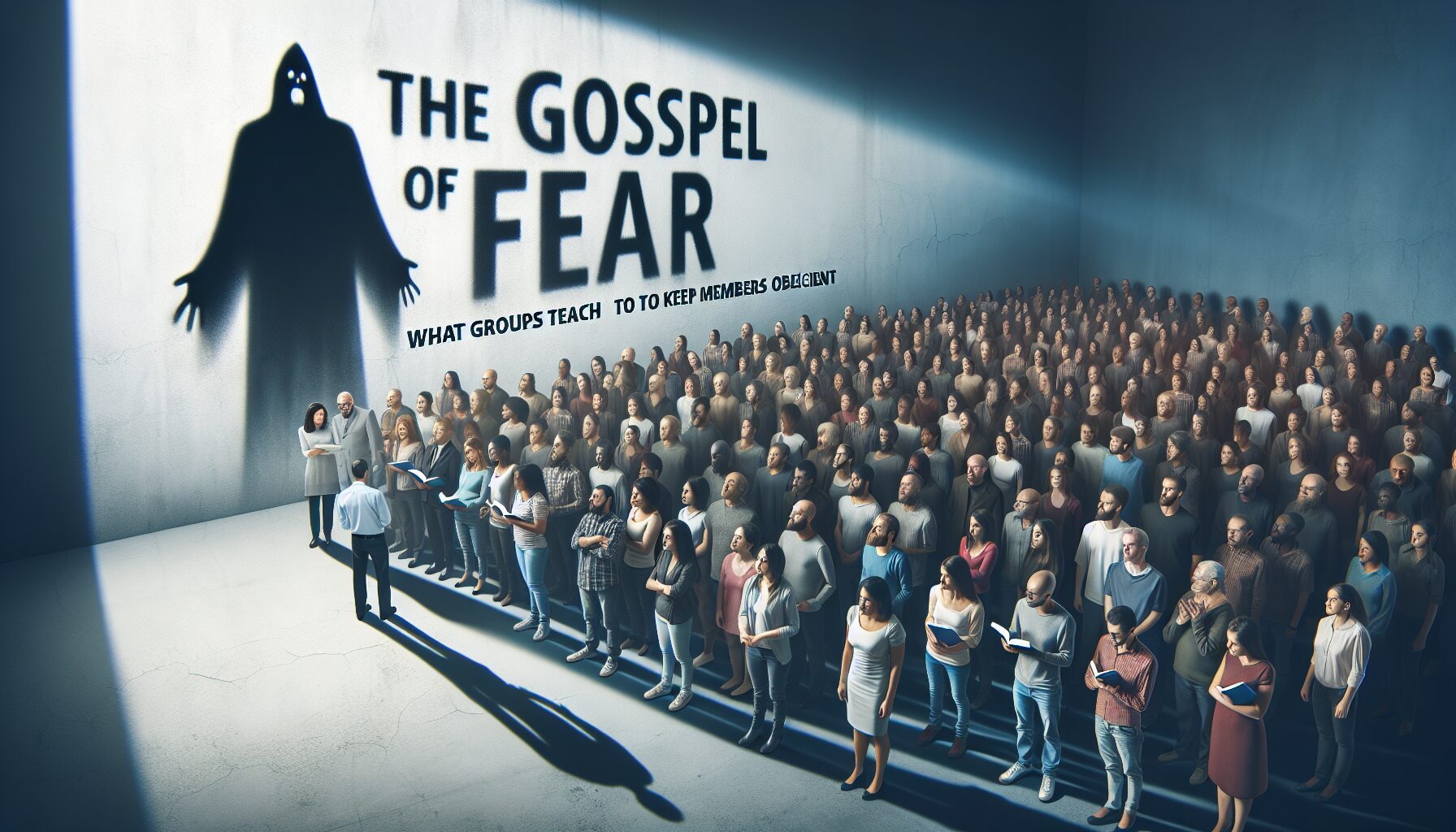
  • The Gospel of Fear – What Groups Teach to Keep Members Obedient

    The Gospel of Fear – What Groups Teach to Keep Members Obedient

    The Gospel of Fear: What Groups Teach to Keep Members Obedient

    Throughout history, groups—from religious sects to cults—have wielded fear as a powerful tool to ensure the obedience of their members. Fear, as a psychological mechanism, can hold sway over a person’s mind, compelling them to adhere to beliefs and practices they may not otherwise follow. But what exactly do these organizations preach to keep their members in line?

    The Foundation of Fear

    The use of fear by groups often begins with the establishment of a fundamental belief system that clearly distinguishes insiders from outsiders. Karl Popper, an influential philosopher, explained this dichotomy in his works: “It is impossible to speak in such a way that you cannot be misunderstood.” Groups leverage this idea by creating a narrative where being misunderstood or diverging from the established path results in dire consequences.

    Apocalyptic Predictions

    Many groups utilize fear by forecasting impending doom if members fail to comply with prescribed doctrines or commandments. Apocalyptic narratives often serve as a motivator for adherence. For instance, Christian eschatology has been a means through which certain religious groups keep followers in line through fear of the end times. In a 2018 Pew Research Study, it was found that a notable percentage of Americans believe in the biblical apocalypse, which illustrates the power and reach of these beliefs.

    Fear of Excommunication and Isolation

    The threat of excommunication or community isolation is another form of fear utilized by groups. This method plays on the human fear of loneliness and exclusion. Scriptures and doctrines are often cited to justify the cutting off of ties. A notable example can be seen in Jehovah’s Witnesses, where the practice of shunning members who dissent serves as a stark warning to maintain conformity, as documented by a BBC article.

    Fear of the Supernatural

    Fear of the supernatural and divine punishment is another tactic. Many religions preach that deviation from the set beliefs and practices will result in eternal damnation or other supernatural retributions. This notion is vividly present in various fundamentalist religious groups where hellfire and divine wrath are recurrent themes in teachings and sermons.

    “Men fear thought as they fear nothing else on earth — more than ruin, more even than death.” – Bertrand Russell

    The Cycle of Fear and Control

    • Cognitive Dissonance: Fear can lead to cognitive dissonance, where individuals perform mental gymnastics to align their fears with their beliefs. This phenomenon makes it difficult for members to critically analyze the doctrines they follow.
    • Continual Surveillance: Groups maintain constant oversight to ensure compliance, often instilling the belief that a higher power or the group itself monitors thoughts and actions.
    • Fear of the “Other”: Xenophobia and the demonization of those outside the group strengthen internal cohesion by creating a fear of external threats.

    The Role of Charismatic Leaders

    Charismatic leaders are adept at exploiting fear to maintain control. By presenting themselves as the only path to salvation or truth, these leaders reinforce members’ fears of what lies beyond the group’s teachings. Historian Margaret Thaler Singer, in her work “Cults in Our Midst”, explores how charisma paired with fear can culminate in intense loyalty and obedience.

    The Path Forward: Education and Awareness

    Understanding the dynamics of fear within groups is imperative for both current members and those studying these organizations. Awareness and education about these fear tactics can be powerful tools in resisting undue influence. Emphasizing critical thinking, fostering community, and seeking supportive interventions can dismantle the control that fear exerts.

    In conclusion, fear is a profound and practical instrument used by groups to maintain obedience among their members. From supernatural threats to social seclusion, these groups exploit fear to insulate members from outside influences and independent thought. Recognizing these tactics is the first step in escaping their grasp and forging a path toward intellectual and emotional autonomy.

  • The Burnt Offering — When sacrifice becomes self-destruction

    The Burnt Offering — When sacrifice becomes self-destruction

    The concept of sacrifice has been woven into the fabric of human civilization since time immemorial. Historically, burnt offerings were seen as acts of devotion meant to appease the gods or seek their favor. However, when does sacrifice cross into the territory of self-destruction? The tale is as old as time and speaks to the heart of human experience, posing questions about the nature and cost of sacrifice.

    Historical Context

    Burnt offerings have a storied history across various cultures and religions. In ancient Judaism, the Olah, or burnt offering, was a central aspect of worship where the consumed flesh symbolized purification and dedication to God (Encyclopedia Britannica). Similarly, in Greek and Roman traditions, sacrifices were made to maintain harmony between humankind and the divine.

    The Thin Line Between Sacrifice and Self-Desecration

    While these acts of sacrifice are meant to reflect devotion, they can also pose a danger. At what point does a noble act of giving oneself over transition into a detrimental phase of self-neglect or destruction?

    “Sacrifice is something that should unfold like a flower… anything that costs them their happiness or peace of mind cannot be good,” remarks psychologist Dr. Elisa Foster, reflecting on the modern implications of sacrificial acts.

    The Metaphor of the Burnt Offering

    Viewed metaphorically, a burnt offering represents any action or behavior where one might give too much of themselves, leading to a hollowing out of personal resources, whether emotional, physical, or spiritual. The workplace is replete with such examples, where ambition and dedication sometimes culminate in burnout rather than ascension.

    • Work-life balance: The horror stories of individuals sacrificing their personal lives for career advancement are abundant and serve as cautionary tales.
    • Emotional investment: Relationships that demand a person’s all, without reciprocation, can deteriorate one’s sense of self-worth and lead to emotional exhaustion.
    • Physical health: Overextending oneself in pursuit of societal ideals of success can lead to chronic stress-related illnesses.

    Finding Balance

    Achieving a balance between what one gives and receives is critical. Sacrifice should not be synonymous with self-abandonment. Instead, it should be a mindful act that leads to growth and fulfillment, rather than depletion.

    In reflecting on the true nature of sacrifice, we must strive to recognize when devotion becomes detrimental and take measured steps toward harmony. Only then can the burnt offering symbolize not the ashes of what we once were, but the fertile ground for what we may become.

  • The Mirror of Authority — What interpreters see when they look inward

    The Mirror of Authority — What interpreters see when they look inward

    When we talk about authority in the realm of literature, we often discuss the authorial voice, editorial influence, or even the societal structures that dictate what stories get told and retold. Rarely, however, do we shine a light on the role of the interpreter—those who translate, critique, and sometimes radically alter the path of a narrative. These interpreters, whether translators, critics, or teachers, play their part in what Harold Bloom termed the “anxiety of influence,” but how do they perceive their own authority?

    The Translator’s Paradox

    The role of a translator is arguably one of the most profound forms of literary interpretation. A translator not only converts text from one language to another but also encapsulates cultural nuances and contexts. As Italian translator and author Umberto Eco wrote in his “Experiences in Translation”, “Translation is the art of failure.” He implies that the act of translating is inherently authoritative because it makes definitive choices while simultaneously acknowledging the inevitable loss of original intent and meaning.

    The Critic’s Lens

    Critics wield considerable authority. Through formal critique or the more modern phenomenon of meta-narrative blogging, they create lenses through which audiences perceive texts. In a way, critics hold up a mirror to text, reflecting and sometimes refracting it to reveal new forms. As Judith Butler asserted in her essay, “Imitation and Gender Insubordination,” a critic may “open the referential field,” reshaping our understanding of what the text can signify.

    “For when a writer’s words are set in parallel motion, when critics dialogue with or about the text, they shape its endlessly permutable essence.” — Cindy Weinstein, Time, Tense, and American Literature

    The Educator’s Role

    Educators, often the first guides into the world of literature for many, establish foundational interpretations for their students. They encourage readers to not just ask what a text means, but what it means to them. In discussing the multiplicity of meanings a text can hold, educators challenge their students to defy singular interpretations, emphasizing personal connection. As William Butler Yeats once remarked, “Education is not the filling of a pail, but the lighting of a fire.”

    • Translators bear the burden of fidelity to both source and target languages.
    • Critics transform perception through critical imagery and theoretical critique.
    • Educators foster individual interpretation, influencing generations of readers.

    Thus, through translation, critique, and education, interpreters do not merely reflect the authority inherent in a text but construct new palimpsests where their voices, choices, and biases become an indelible part of what the text represents in diverse cultural milieus.