
Tag: violence

  • The Cult Label – How “Othering” language is used to justify violence.

    The Cult Label – How “Othering” language is used to justify violence.

    The Cult Label – How “Othering” Language is Used to Justify Violence

    The term “cult” has become synonymous with danger and fanaticism, evoking images of brainwashed followers and apocalyptic prophecies. But is the label fair, or does it perpetuate a harmful narrative that justifies violence against minority groups? In recent years, high-profile cases like the FLDS and NXIVM have brought the concept of cults into the public eye, sparking heated debates about free will, manipulation, and the boundaries between religion and criminal activity.

    The Power of Language

    Sociologist and author Jeffrey Hadden argues that the term “cult” is often used as a pejorative to describe minority religions or groups that don’t conform to societal norms. “The label ‘cult’ is used to discredit, dehumanize, and delegitimize,” he says in an interview with The Conversation. “It’s a way to say, ‘These people are not like us, they’re weird, and they’re dangerous.’”

    A History of Prejudice

    The term “cult” has its roots in the 17th-century European witch hunts, where anyone deemed outside the mainstream was labeled a “witch.” This “othering” language served as a justification for violence and persecution. Today, the same pattern is seen in modern society. A study by the University of California, Berkeley found that anti-cult rhetoric often relies on stereotypes and misinformation to discredit minority groups.

    The Cult Label’s Consequences

    The use of the term “cult” can have devastating consequences for individuals and communities. In a New York Times piece, journalist Rachel Aviv describes how the label has been used to justify violence against minority religions like Jehovah’s Witnesses and Muslims. “When people are labeled ‘cults,’ it allows them to be treated as an enemy, rather than a group of human beings with beliefs and practices,” she writes.

    A Call for Nuance

    Scholars argue that the term “cult” is too broad and lacks nuance, failing to distinguish between legitimate religious groups and those that may warrant concern. A report by the International Cultic Studies Association emphasizes the importance of understanding the complexities of minority religions and avoiding sensationalized language.

    Beyond the Label

    So what’s the solution? Experts suggest focusing on the individual actions and behaviors, rather than making sweeping judgments about entire groups. “We should be concerned with people’s behavior, not their beliefs or affiliations,” says Hadden. “Let’s focus on creating a society that values free speech, assembly, and association – without resorting to demonizing labels.”

    Related Reading

    “The cult label is a tool of oppression, used to silence and marginalize minority groups. It’s time for a more nuanced understanding of religious freedom and the importance of respecting all belief systems.” – Jeffrey Hadden
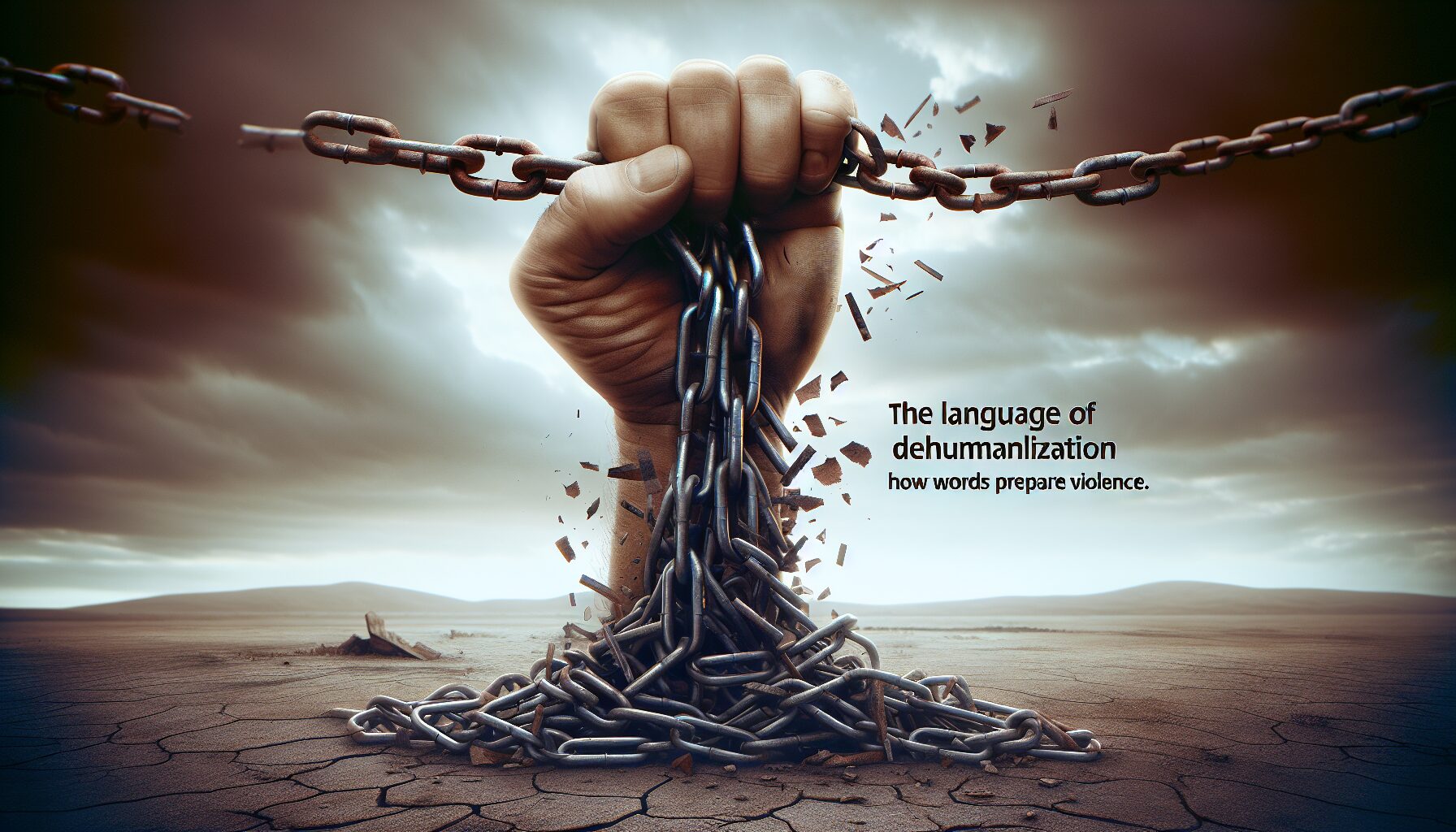

  • The Language of Dehumanization – How words prepare violence

    The Language of Dehumanization – How words prepare violence

    The Language of Dehumanization: How Words Prepare Violence

    Throughout history, the words we choose have often paved the way for actions, setting the tone for both collaboration and conflict. The power of language lies not only in its ability to inform and persuade but also in its potential to dehumanize and incite violence. Examining the mechanisms behind this linguistic phenomenon is vital in understanding how societies can fall into cycles of aggression.

    The Mechanisms of Dehumanization

    Dehumanization is the psychological process of demonizing the enemy, making them seem less than human and hence not worthy of humane treatment. This is often a precursor to violence, as it lowers the innate moral inhibitions that people have towards harming others. Language plays an integral role in this process.

    • Name-calling and Labeling: The first step in dehumanization often involves the use of derogatory labels. Such terms reduce individuals to undesirable stereotypes. For instance, the Rwandan genocide saw the use of the term “cockroaches” to describe the Tutsi population, effectively reducing them to vermin in the eyes of Hutu extremists.
    • Metaphors and Euphemisms: Using metaphors and euphemisms can mask the brutality of acts of violence. This can be seen in military jargon—terms like “collateral damage” or “neutralizing the target” which sterilize the reality of destruction and death.
    • Narratives of Threat: Language that frames others as existential threats can galvanize support for preemptive aggression. Adolf Hitler’s rhetoric of the ‘Jewish threat’ in pre-World War II Germany mobilized a nation leading to horrific atrocities.

    Historical Examples of Linguistic Dehumanization

    History is replete with instances where language laid the groundwork for widespread violence. A classic example is the 20th-century totalitarian regimes, which often relied heavily on propaganda to justify their actions.

    • Nazi Germany: The Nazis mastered the art of propaganda, making extensive use of vilifying language. Joseph Goebbels, the Minister of Propaganda, used media to inculcate the German public with anti-Semitic sentiment. A quote from historian Ian Kershaw illustrates this well:

      “The success of Nazi propaganda simply shows how easily people can be manipulated when fear and distance are created between groups.”

    • Rwanda: The Rwandan genocide was preceded by a period of intense media campaigns. Radio broadcasts referred to Tutsis as “inyenzi,” or cockroaches, contributing heavily to the dehumanization that enabled violence. According to a BBC report, the use of language that evokes fear and disgust played a key role in persuading ordinary citizens to commit acts of unspeakable violence against their neighbors.

    The Psychological Impact of Dehumanizing Language

    The psychological impact of such dehumanizing language cannot be underestimated. It erodes empathy and creates an ‘us versus them’ mentality. Research from The Journal of Personality and Social Psychology indicates that exposure to dehumanizing terms leads individuals to perceive out-groups as less human, reducing empathy and moral restraint.

    Such exposure also desensitizes people to violence, making atrocities seemingly acceptable or justified. This is evident in modern-day conflicts where both sides use inflammatory language to describe their opponents, thus perpetuating cycles of violence and mistrust.

    Modern-day Implications of Dehumanizing Rhetoric

    In the age of digital communication, the speed at which such rhetoric can spread poses a significant challenge. Social media platforms have become conduits for dehumanizing language, often allowing it to reach a global audience within seconds.

    To combat this, experts like technology critic Anil Dash emphasize the role of platforms in moderating content and educating users about the impact of their language. In his words, “We must hold platforms accountable for the role they play in amplifying this kind of harmful rhetoric.”

    Conclusion: The Call for Conscious Language

    The language used to describe others is not just a matter of semantics—it has the power to catalyze action, foster peace, or spur violence. Recognizing the role of dehumanizing language in preparing societies for violence is the first step toward breaking this vicious cycle. Ensuring that we choose words carefully, promoting inclusive narratives, and fostering empathy can create societies resilient against the siren call of dehumanization.

    Ultimately, becoming conscious of the language we use is crucial in striving toward a more harmonious and understanding world.

  • Rise of the Scapegoat – How Outsiders Become Symbols

    Rise of the Scapegoat – How Outsiders Become Symbols

    The concept of the scapegoat has roots deeply entrenched in ancient mythology, religious rituals, and societal practices. From isolated tribes to modern-day societies, the notion of casting blame onto an outsider or a minority serves as a coping mechanism, a means to unite the majority against a common ‘other.’ This article delves into how and why outsiders so frequently become symbols of societal tensions and conflicts.

    Origins of the Scapegoat

    The term “scapegoat” originates from the Jewish Day of Atonement ceremony, described in the Book of Leviticus (16:8-10). During this ritual, a goat was symbolically burdened with the sins of the people before being driven into the wilderness, hence removing guilt from the community.

    “Aaron shall lay both his hands on the head of the live goat and confess over it all the wickedness and rebellion of the Israelites—all their sins—and put them on the goat’s head. He shall send the goat away into the wilderness in the care of someone appointed for the task.”

    — Leviticus 16:21-22, NIV Bible

    Mythological Foundations

    Scapegoating appears in different forms across various cultures. For instance, the ancient Greek myth of Oedipus reflects the tragic consequences of scapegoating. In Oedipus’ case, the plague upon Thebes was lifted when he, uncovered as the cause of its calamities due to patricide and incest, was sent into exile. Such narratives reflect the intricate dynamics of guilt and sacrificial expulsion where an individual bears the collective burdens of their community’s transgressions.

    Psychological Implications

    Renowned psychiatrist Sigmund Freud and his successor René Girard explored the psychology behind scapegoating. Freud discussed the concept of “projection,” where individuals & communities displace their own undesirable traits onto another person or group. Girard took this further in his “mimetic theory,” which argues that human desires are imitative and can lead to rivalry and violence, ultimately resolved through scapegoating.

    “Men fight precisely because they desire the same things… Desire always appears as spontaneous, autonomous and innocent. It simultaneously conceals its own violence and confers a falsely positive character on the violence it engenders.”

    — René Girard, Author of “Violence and the Sacred”

    The Role of Fear and Uncertainty

    Historically, during periods of uncertainty and fear—such as plagues, economic downturns, or political instability—outsiders often become scapegoats. The Spanish Influenza outbreak of 1918 is a poignant example. Immigrants and minority classes were often blamed for the spread of the disease, illustrating how societal stress can pinpoint blame onto those seen as ‘different’ or ‘other’ without scientific backing.

    In more contemporary contexts, the COVID-19 pandemic reiterated similar patterns. Misguided blame towards specific ethnicities or international travelers reflects the perennial human tendency to simplify complicated issues by attributing fault to distinct groups.

    Contemporary Scapegoating and Its Consequences

    Today, scapegoating remains an insidious part of politics and society. Nationalism often capitalizes on creating a scapegoat to fortify group identity and justify exclusionary policies. The use of rhetoric against outsiders—whether they be immigrants, political adversaries, or minority religious groups—is not merely a throwback to antiquated practices but an ongoing reality.

    The impact of scapegoating can be devastating, leading to discrimination, social unrest, and even violence. Consider the plight of Rohingya Muslims in Myanmar or the rise in hate crimes against Asian communities during global health crises. These instances underscore scapegoating’s potential to escalate from speech into systemic oppression or violence.

    Countering the Scapegoat Phenomenon

    • Education: Teaching critical thinking and empathy can help dismantle irrational fears and misconceptions about ‘the other.’
    • Dialogue: Encouraging conversation between diverse groups fosters understanding and diminishes the space for scapegoating narratives.
    • Policy: Implementing and enforcing anti-discrimination laws can provide a framework for protecting vulnerable communities and holding perpetrators accountable.

    Efforts to overcome scapegoating should also involve acknowledging historical wrongs and striving to rectify past injustices. Vibrant, inclusive communities thrive on understanding rather than division, offering a more peaceful and equitable coexistence as the ultimate antidote to the scapegoat phenomenon.

    Conclusion

    The rise of the scapegoat as a symbol of collective human tension underscores both our primal instincts to unite against perceived threats and the capacity for progress through enlightened understanding. While scapegoating addresses immediate psychological needs, it ultimately serves as a poor substitute for genuine resolution and growth. Reflecting on these patterns invites a collective striving towards justice and unity, dismantling centuries-old narratives and forging a new, inclusive path for future generations.

  • Sanctified Violence – When Faith Justifies Harm

    Sanctified Violence – When Faith Justifies Harm

    Sanctified Violence: When Faith Justifies Harm

    Throughout history, faith has been a cornerstone of human culture, offering solace, guidance, and a moral compass. However, it has also been wielded as a tool for justifying acts of violence. The dichotomy of religion as both a force for good and a pretext for conflict raises intricate questions about the nature of belief and the complexities of human morality.

    The Historical Context of Sanctified Violence

    Historically, religious violence can be traced back to the dawn of organized faiths. From the Crusades in the Middle Ages to ancient religious wars, actions undertaken in the name of a higher power have profoundly shaped the world’s geopolitical landscape.

    “In the name of God and perpetrated in the nature of belief, religion often ignites more wars than it pacifies,” notes the BBC in a discussion of historical religious conflicts (BBC).

    These conflicts are often exacerbated by the absolutist nature of religious doctrines. When individuals or groups believe they possess the sole truth, it can justify the eradication of dissenting beliefs, sometimes through violent measures.

    Religious Extremism: A Modern Challenge

    In the contemporary world, religious extremism continues to be a significant source of violence. Groups such as ISIS and Boko Haram use radical interpretations of religious texts to justify terror and disorder. This form of sanctified violence is not confined to any single faith but is a global phenomenon, affecting societies worldwide.

    “As religious extremism increases, so do incidents of violence and conflict in the name of God,” writes The Washington Post (Washington Post).

    Religious leaders and scholars often emphasize that extremism distorts the core teachings of their respective faiths, which typically advocate peace and compassion. The deviation from mainstream religious tenets to justify harm underscores the complicated relationship between belief and violence.

    The Psychology Behind Faith-Justified Harm

    Understanding why faith justifies harm requires delving into the psychology of belief. Cognitive dissonance, groupthink, and indoctrination play critical roles in aligning individual actions with violent religious ideologies.

    • Cognitive dissonance: The mental discomfort a person experiences when holding two or more contradictory beliefs. To alleviate this, individuals may reinterpret religious teachings to align with their violent actions.
    • Groupthink: Within intense religious communities, the pressure to conform can suppress dissenting thoughts and foster unanimity in harmful beliefs or actions.
    • Indoctrination: Continuous exposure to radical ideologies can erode one’s ability to question and independently assess moral actions, leading to acceptance of violence as a divine mandate.

    Psychotherapist Dr. John Smith posits, “When people feel a divine cause sanctions their actions, their sense of personal accountability diminishes, sometimes leading to extreme behavior” (Psychology Today).

    Addressing and Mitigating Religious Violence

    Efforts to mitigate violence justified by faith must be multifaceted, involving education, dialogue, and policy. Promoting religious literacy helps demystify and dispel misconceptions, reducing the susceptibility to radical ideologies. Interfaith dialogues can foster understanding and break down barriers between disparate religious groups.

    “Engaging religious leaders in peace-building actions is crucial,” states a report by the United Nations (United Nations), highlighting the importance of collaboration in addressing faith-based violence.

    Moreover, policies aimed at social integration and economic equity can diminish the appeal of extremist ideologies by addressing the socioeconomic grievances often exploited by radical groups.

    Conclusion

    While faith offers profound personal and communal benefits, its potential to justify violence remains a challenge. By understanding the historical, psychological, and social factors that contribute to sanctified violence, societies can work towards minimizing its occurrence. Faith, when misused, can wield tremendous destructive power. But when harnessed for understanding and compassion, it has the potential to be a formidable force for peace.

  • Soft Violence – The Hidden Attacks No One Sees

    Soft Violence – The Hidden Attacks No One Sees

    Soft Violence: The Hidden Attacks No One Sees

    In the shadows of everyday interactions, a subtle and often overlooked form of aggression lurks—soft violence. Unlike the physical blows that are more easily spotted and addressed, soft violence consists of nuanced, psychological attacks that manipulate and degrade their victims’ emotional and mental stability.

    Understanding Soft Violence

    Soft violence can best be described as a suite of behaviors that aim to silently undermine one’s self-esteem, confidence, and sense of reality. These behaviors include gaslighting, passive-aggression, silent treatment, and persistent criticism. According to renowned psychologist Paula E. Caplan, “Gaslighting produces anxiety, depression, and a variety of self-doubt in the victim.” (Psychology Today October 2019).

    Victims of soft violence often find themselves in a continuous loop of self-doubt and psychological disarray. The subtlety of these attacks makes them difficult to address and leaves many victims questioning the validity of their experiences.

    Common Forms of Soft Violence

    • Gaslighting: This involves making someone doubt their memories or perceptions through outright denial, manipulation, and lying.
    • Passive Aggression: This indirect expression of hostility can manifest as procrastination, feigned incompetence, or deliberate failure to complete tasks.
    • Silent Treatment: Using silence as a weapon to control or punish the victim.
    • Persistent Criticism: Constant, subtle put-downs that erode a person’s self-worth over time.

    The Impact of Soft Violence

    While it may not result in physical scars, soft violence leaves profound psychological impacts. Victims often experience chronic stress, anxiety, and depression. In the words of Dr. Deborah Khoshaba, “The scars that are suffered are deep and often ignored because they lack the physical manifestation.”

    Addressing Soft Violence

    To combat soft violence, awareness must be raised about its existence and consequences. Open dialogues about mental health and emotional abuse are crucial steps to empower victims and hold perpetrators accountable. Staging interventions or seeking professional guidance can provide the necessary support for those entangled in such toxic dynamics.

    “Emotional abuse is just as damaging as physical abuse, though it is often harder to recognize and comes with the excuse that it’s not really that bad.” — Cat Lantigua, Everyday Feminism (2015)

    By spotlighting these hidden attacks, society can foster a more supportive environment for victims, helping them reclaim their power and sense of self-worth.