
Tag: narratives

  • The Soviet Silence – Recovering the myths suppressed by the Iron Curtain.

    The Soviet Silence – Recovering the myths suppressed by the Iron Curtain.


    The Soviet Silence – Recovering the myths suppressed by the Iron Curtain

    The Soviet Silence

    “In the heart of the Iron Curtain, whispers of tales untold echoed through the labyrinths of time.” – Anonymous Mythographer

    As the veil of secrecy that once shrouded the Soviet Union began to dissipate, a chorus of voices rose from the depths, seeking to weave their suppressed narratives into the fabric of history. The Soviet Silence, as this era has come to be known, represents not just a void in the historical record, but a vast repository of myths and legends that were intentionally hidden or overlooked during the Cold War.

    Ancestral Echoes

    • The stories that emerged from this era are as diverse and complex as the land they sprang from, mirroring the rich tapestry of Russian mythology that predated the Soviet regime. From tales of cosmic battles fought by mystical beings to epics centered around the exploits of legendary heroes, these narratives offer a unique glimpse into a culture that was often obscured by political ideology and censorship.
    • One such story is that of “The Firebird,” a mythological creature said to possess a magical feather capable of igniting an endless flame. This symbol of hope and light found its way into Russian folklore long before the Soviet era, yet it was during this time that its meaning evolved to encompass the struggle for freedom and the yearning for truth.

    The Iron Curtain’s Shadow

    The Soviet Silence, however, was not merely a repository of ancient stories; it also served as a testing ground for the propagation and manipulation of myths that supported the regime’s ideological objectives. These manufactured narratives were designed to create a sense of unity among the people while masking the realities of life under Soviet rule.

    “The Iron Curtain did not just separate nations; it also sought to divide truth from myth, casting a long and dark shadow over our collective memory.” – Boris Pasternak

    Breaking the Silence

    As the Soviet Union crumbled and its secrets began to spill out into the world, scholars and mythographers worked tirelessly to uncover the buried tales that had been silenced by the Iron Curtain. Through painstaking research and collaboration, these dedicated individuals sought to piece together the fragmented narratives that had been lost for generations.

    “In recovering these myths, we are not just restoring a lost chapter in history; we are also healing the wounds inflicted by decades of political repression.” – Svetlana Alexievich

    The Legacy of the Soviet Silence

    Today, the myths that emerged from the Soviet Silence continue to captivate audiences around the world. Through their exploration and interpretation, these stories serve as a reminder of the power of narrative in shaping our understanding of history and ourselves. As we delve deeper into the heart of the Iron Curtain’s legacy, we are reminded that every voice deserves to be heard, and every story has the potential to transform us.

  • Modernity’s Intolerance – Why progress narratives erase spiritual heritage

    Modernity’s Intolerance – Why progress narratives erase spiritual heritage

    Modernity’s Intolerance: Why Progress Narratives Erase Spiritual Heritage

    In our fast-paced, technologically driven world, the narrative of progress often dominates our understanding of societal development. This prevailing narrative equates progress with scientific advancement and technological innovation. However, as we march forward, this perspective has inadvertently sidelined and, at times, actively erased spiritual heritage. This article explores how modernity’s intolerance is reshaping cultural landscapes and eroding the spiritual foundations that have been integral to human societies.

    The Progress Narrative: A Double-Edged Sword

    The narrative of progress that underpins modern society is often equated with notions of economic growth, technological advancements, and scientific rationality. This narrative assumes that human history is a lineal journey from primitivism towards enlightenment, marked by technological triumphs and scientific breakthroughs. Such a perspective, while fostering innovation and improving living standards, often diminishes the value of spiritual and cultural traditions.

    • Economic and Technological Focus: The emphasis on economic performance and technological prowess often creates an environment where spiritual values are viewed as obstacles to growth. As societies prioritize GDP growth and technological superiority, traditional practices and beliefs are sidelined or deemed archaic.
    • Scientific Rationalism: The rise of scientific rationalism in the modern era has positioned empirical analysis and objective reasoning as the ultimate paths to truth and knowledge. While this has led to phenomenal advancements, it has often delegitimized forms of knowledge rooted in spirituality.

    The Cultural Erosion of Spiritual Heritage

    As the world becomes increasingly connected through globalization and digitization, cultural homogenization poses a significant threat to spiritual diversity. The global spread of Western modernity often carries with it the unintentional consequence of eroding indigenous cultures and spiritual practices.

    • Globalization and Cultural Homogenization: Global markets and media have a pervasive influence on cultural expressions, often prioritizing Western cultural products over indigenous traditions. This leads to a homogenization of cultural norms, overshadowing diverse spiritual practices.
    • Urbanization and Displacement: The migration from rural areas to urban centers in search of economic opportunities often results in the loss of connection to ancestral lands and traditional spiritual practices tied to them.

    Paul Kingsnorth’s Perspective on Progress and Spirituality

    “Our myth is ‘Progress’,” says author Paul Kingsnorth, “and its inevitability is rarely questioned… but in reality, progress has always been a double-edged sword.” (The Guardian)

    Kingsnorth critiques progress narratives by arguing that they often dismiss the complex, interconnected relationship between humans and their spiritual environments. These progress narratives can impose a singular way of life that negates the essential spiritual experiences that have been nurtured by communities for centuries.

    Preserving Spiritual Heritage in a Modern Age

    Preserving spiritual heritage amid advancing modernity necessitates a balanced approach that respects the role of technological progress without compromising spiritual identities. Strategies include:

    • Integrating Spirituality with Modern Practices: Encouraging practices that merge traditional spiritual rituals with modern lifestyles, thus creating a symbiotic relationship rather than a confrontational one.
    • Promoting Cross-Cultural Education: Education systems that include teachings of diverse spiritual traditions can foster understanding and appreciation of cultural heritage.
    • Supporting Indigenous Movements: Promoting and supporting initiatives by indigenous communities that aim to protect and revive their spiritual and cultural practices.

    The Role of Modern Spiritual Movements

    Modern spiritual movements play a crucial role in bridging the gap between ancient wisdom and contemporary life. Practices such as mindfulness, yoga, and holistic medicine, which draw from ancient spiritual traditions, are seeing a resurgence in popularity in Western societies. These practices suggest a growing awareness of the benefits of integrating spiritual elements into modern living, emphasizing balance between technological advancements and spiritual well-being.

    Conclusion: Embracing Diverse Narratives

    While progress and technological advancements undoubtedly offer numerous benefits, it is crucial to acknowledge and preserve the spiritual heritages that enrich human existence. This requires a conscious effort to create narratives that value both scientific achievements and the wisdom of spiritual traditions. By cultivating a societal framework that embraces diverse perspectives, humanity can steer towards a future that honors its past.

    As society stands at a crossroads, there exists an opportunity to redefine modernity—one that recognizes that true progress includes the spiritual well-being of individuals and communities. In this reconceptualized modernity, spiritual heritage is not merely an artifact of the past but a vibrant and essential part of our collective future.

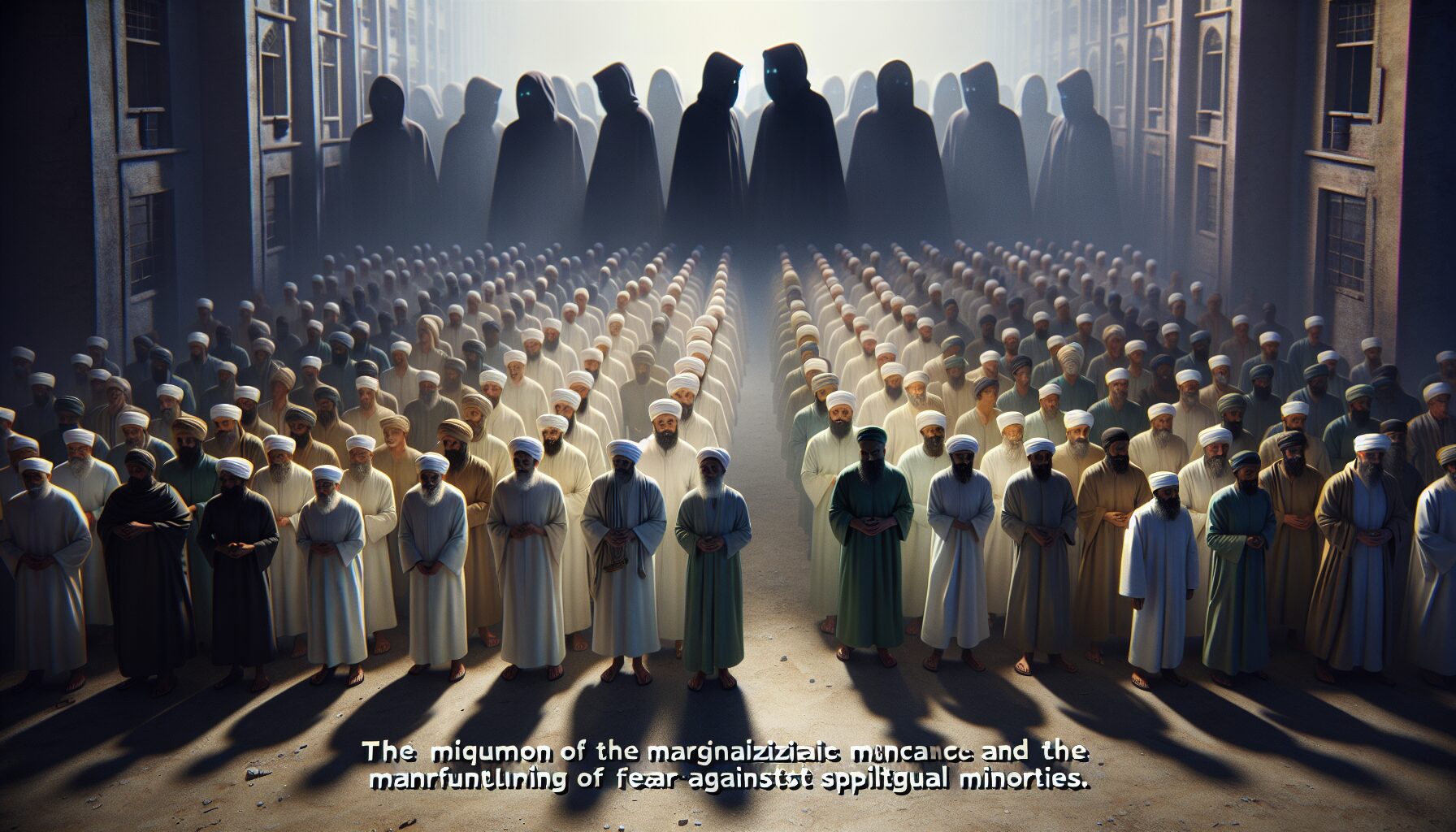
  • From Margins to Menace – Manufacturing fear of spiritual minorities

    From Margins to Menace – Manufacturing fear of spiritual minorities

    From Margins to Menace: Manufacturing Fear of Spiritual Minorities

    Throughout history, spiritual minorities have often found themselves in precarious positions within mainstream society. These groups are frequently marginalized and, at times, portrayed as societal threats. This phenomenon raises important questions about the sources and perpetuation of fear towards spiritual minorities.

    The marginalization of spiritual minorities is not a new occurrence. From early Christians in the Roman Empire to modern-day new religious movements, fear and misunderstanding have often fueled mistrust and persecution. But how does this fear arise, and what keeps it alive?

    The Roots of Fear

    At the heart of this fear is often a lack of understanding and the portrayal of these groups as ‘other.’ In his book, The Culture of Fear, sociologist Barry Glassner discusses how media and cultural narratives can amplify fear by exaggerating threats or focusing on sensational stories.[1]

    “When we focus on fear, we produce more fear. And when we portray those who are different as threatening, we invite suspicion and discrimination,” explains Glassner.[2]

    The Role of Media

    The media plays a significant role in shaping public perception. Coverage often highlights the most extreme or controversial aspects of spiritual minorities, feeding into existing stereotypes. The case of the Waco siege in 1993, involving the Branch Davidians, is a prime example. Intense media scrutiny and sensationalized reporting painted the group in a violent light, reinforcing public fear.[3]

    • Selective Coverage: Highlighting negative aspects while ignoring ordinary, peaceful practices.
    • Insider vs. Outsider Narratives: Encouraging a sense of ‘us vs. them’ through biased storytelling.

    The Impact on Society

    Such narratives not only impact the targeted groups but also influence societal norms and policies. History has shown us that manufactured fear can lead to discrimination, social exclusion, and even violence. It underscores the need for a more nuanced understanding and reporting of spiritual minorities.

    Moving Forward

    As society becomes more interconnected, fostering understanding and dialogue is crucial. Recognizing and challenging the narratives that drive fear can lead to more inclusive communities. Encouraging critical media consumption and supporting diverse voices are steps toward breaking the cycle of fear.

    In the words of cultural historian Karen Armstrong, “Compassion is the key.” Understanding and embracing spiritual diversity, rather than vilifying it, can help bridge divides and diminish unfounded fears.[4]