Tag: moral

  • The Myth of Non-Interference — Why neutrality favors injustice

    The Myth of Non-Interference — Why neutrality favors injustice

    One of the oldest adages in the realm of conflict is the notion of neutrality. It might be visualized as a serene lake amidst a forest raging with tempests. However, the idea that maintaining neutrality in the face of injustice is somehow a moral stance is increasingly being challenged. In practice, neutrality often tacitly endorses injustice, for when the scales are uneven, refusing to weigh in does not mean balance, but rather reinforces the prevailing imbalances.

    The Allure of Neutrality

    “In the end, we will remember not the words of our enemies, but the silence of our friends,” observed Dr. Martin Luther King Jr., a powerful critique of the notion of staying neutral in situations demanding justice. The allure of taking a neutral stance comes from a desire to avoid conflict, perceived as a path of peace and harmony. This is encapsulated in Maxwell Maltz’s statement that, “The price of neutrality is often much more expensive than not making a decision.”

    Neutrality promises a haven from the chaos, urging individuals to step aside as opposing forces clash. But in sidestepping these battles, does neutrality truly live up to its ideal of impartiality, or does it become complicit?

    When Neutrality Becomes Complicity

    Silence in the Face of Oppression

    • Historical Context: History is replete with examples where neutrality has served as a veil for complicity. During the Holocaust, the reluctance of many nations to intervene or speak out against Hitler’s regime allowed atrocities to proliferate unabated until it was nearly too late. The U.S. Holocaust Memorial Museum states,

      “Indifference and inaction often increase the opportunities for wrongdoing.”

    • Contemporary Examples: Consider the ongoing humanitarian crises around the world. When global leaders choose neutrality amid ethnic cleansing or systematic oppression, it’s the marginalized and vulnerable who suffer the consequences.

    The Façade of Impartiality in Political Conflicts

    Neutrality in complex geopolitical landscapes is often seen as synonymous with impartiality. Yet, when the scales of justice are unbalanced, choosing not to interfere is rarely a neutral act. In the Israeli-Palestinian conflict, for example, international neutrality is often criticized as tacit support for the status quo. Noam Chomsky has argued that this kind of neutrality serves as a de facto endorsement of powerful state actors over oppressed populations.

    Why Neutrality is Not Merely Non-Action, But Wrong Action

    • The Balance of Power: By staying neutral, one inadvertently supports the more powerful party in a conflict because doing nothing changes the status quo. As Desmond Tutu has famously stated,

      “If you are neutral in situations of injustice, you have chosen the side of the oppressor.” (NPR)

    • The Ethics of Indifference: In many situations, the moral landscape does not allow for middle ground. Ethicists argue that in conflicts involving fundamental human rights violations, a neutral stance equals complicity.

    Case Studies Demonstrating the Fallacy of Neutrality

    • The Rwandan Genocide: The international community’s delayed response and initial claim of neutrality in Rwanda led to one of the most horrific massacres in modern history, resulting in an estimated 800,000 deaths. The UN‘s non-interference is now considered a glaring failure.
    • Environmental Issues: When political leaders adopt neutral stances regarding climate change, the lack of assertive action favors the continuation of harmful industrial practices, significantly harming the planet.

    The Moral Imperative to Act

    While neutrality offers a semblance of moral high ground, it often leads to a fertile ground where injustice festers and grows. Acknowledging the pitfalls of neutrality sets the stage for decisive action.

    • Active Advocacy: Becoming a proactive advocate for justice enables individuals and nations to constructively confront inequities. When stakeholders take clear stances, they pave the way for systemic changes and policies that foster fairness.
    • Building Inclusive Communities: Instead of withdrawing, engaging in dialogue and forming alliances across different communities can catalyze change. This approach promotes understanding and defuses potential conflicts from holding sway unchecked.

    Conclusion: Embracing a Stance Beyond Neutrality

    Neutrality in the face of injustice is not the absence of choice but rather a choice that too often sides with oppression. As global citizens, recognizing the myth of non-interference can push us towards deliberate engagement and the relentless pursuit of justice. Ultimately, the world benefits not from those who remain oblivious or indifferent, but from those who dare to speak truth to power and confront inequity with courage.

    It is time to reframe neutrality as a potential ally of injustice, and instead, courageously promote active interventions that align with the principles of fairness and equality for all. For, as history instructs us and as current events continue to reveal, silence, while reassuring, echoes the despair of those whose voices remain unheard, and whose plights deepen with every moment of averting eyes.

  • Responsibility Beyond Rank — Moral accountability without hierarchy

    Responsibility Beyond Rank — Moral accountability without hierarchy

    Responsibility Beyond Rank: Moral Accountability Without Hierarchy

    In the complex web of organizations, accountability often trickles down through ranks, with the higher-ups calling the shots and the lower ranks executing them. But is responsibility truly tethered only to hierarchy? The increasing dynamism and autonomy of modern workplaces invite a deeper examination into moral accountability beyond rank.

    The Traditional Model of Accountability

    Traditionally, accountability in organizations has been closely linked with an individual’s position in the hierarchy. A Harvard Business Review article points out, “Responsibility without authority is a recipe for frustration and limited impact.” In many organizations, the decision-making power rests with those at the top, while the responsibility to implement those decisions flows downwards, often without proportionate empowerment.

    The Growing Need for Moral Accountability

    However, organizational dynamics are rapidly changing. With a rise in collaborative work cultures, flexible roles, and the gig economy, the need for individual moral accountability is becoming ever more critical. The question emerges: how can organizations foster a culture where moral responsibility is shared irrespective of rank?

    Empowering Individuals

    To cultivate a culture of shared accountability, organizations can take several steps:

    • Encourage Open Communication: Create channels where voices from all levels can express concerns and ideas. This not only democratizes decision-making but also instills a sense of responsibility in every employee.
    • Foster Ethical Leadership: Leaders must model ethical decision-making. As noted by Kellerman in her book, The End of Leadership, ethical leadership is not about having the answers but about fostering an environment where ethical concerns are openly discussed.
    • Provide Continuous Education: Continuous training and workshops on ethics and moral responsibilities help employees at all levels understand the broader impact of their actions.

    Case Studies of Moral Accountability

    Many organizations have recognized the importance of moral accountability beyond rank. Consider the example of Patagonia, a company noted for its commitment to environmental responsibility. All employees are encouraged to participate in sustainability initiatives, reinforcing moral responsibility at every level. According to their mission statement, “We’re in business to save our home planet,” this encapsulates moral accountability beyond traditional roles.

    “Build the best product, cause no unnecessary harm, use business to inspire and implement solutions to the environmental crisis.” – Patagonia Mission Statement

    The Role of Technology

    Technology also plays a crucial part in this shift. Digital platforms and tools have made it easier for employees to access information and communicate across different levels, promoting transparency and shared accountability. A Forbes article indicates that technology enables more horizontal communication structures, fostering a culture where accountability is a shared value.

    Challenges and Considerations

    Of course, shifting from rank-based responsibility to moral accountability comes with its challenges. Resistance to change is a natural human inclination. Some organizations may face pushback from employees comfortable with the existing structure. It requires time, consistent effort, and commitment from leadership to cultivate a culture that values shared responsibility.

    • Balancing Authority and Accountability: While the goal is to share accountability, it’s essential to ensure that authority and decision-making do not become diluted, leading to confusion.
    • Aligning Personal and Organizational Values: Individuals might have differing values, which may sometimes conflict with organizational goals. It is crucial for organizations to align personal values with their mission.

    Conclusion

    Responsibility beyond rank challenges the status quo of traditional hierarchical structures, proposing a more inclusive and morally accountable work environment. As organizations continue to evolve, embracing shared moral responsibility offers the potential for more ethical, transparent, and effective workplaces. Truly, moral accountability transcends rank and becomes a shared endeavor.

    Ultimately, organizations willing to traverse this path will likely find themselves richer in diversity of thought and unity in purpose, crafting a culture where responsibility is collective, and accountability is universal.

  • The Burden of the Leader — Spiritual authority and moral weight

    The Burden of the Leader — Spiritual authority and moral weight

    Throughout history, leaders have been venerated, scrutinized, and at times, even vilified. The burden of leadership extends far beyond temporal power; it encompasses a spiritual authority and a profound moral weight that have been echoed across civilizations and epochs. This complex dynamic of leadership invokes questions of responsibility, ethics, and the intricate weave of influence over both the psyche and the soul of their followers.

    The Concept of Spiritual Authority

    At its core, spiritual authority refers to the moral and ethical dimension of leadership. It is the intangible quality that compels followers to trust, respect, and seek guidance. In examining spiritual authority, one can look to figures such as Mahatma Gandhi, whose teachings and philosophies on non-violence shaped a nation and inspired global movements. Gandhi once said, An eye for an eye will only make the whole world blind. His words exemplify the influence of spiritual authority that transcended his immediate community to impact the world at large.

    Moral Weight and Ethical Responsibility

    Moral weight refers to the ethical responsibilities that weigh on leaders, often requiring them to navigate complex moral dilemmas while maintaining integrity and a sense of justice. This ethical burden often manifests in decisions that can alter the course of history. Former U.S. President Dwight D. Eisenhower encapsulated this when he remarked, The supreme quality for leadership is unquestionably integrity. He understood that the moral weight of leadership lies not only in personal integrity but also in the expectation that leaders will reflect this quality in their governance.

    The Dual Nature of Leadership

    Leadership carries a duality—inherent power and profound responsibility. Leaders wield the ability to enact change, but with that power comes the onus to ensure such change is ethical and beneficial. Consider Nelson Mandela, whose leadership during South Africa’s transition from apartheid to democracy was marked by a deep commitment to reconciliation and justice. Mandela stated,Real leaders must be ready to sacrifice all for the freedom of their people. This acknowledgment of sacrifice underscores the dual nature of leadership as both a privilege and a profound obligation.

    The Psychological Implications

    Beyond philosophical and ethical considerations, the psychological implications of leadership are significant. The pressure to maintain high moral and spiritual standards can be immense, leading to stress and burnout. According to an article in the Harvard Business Review, leaders often face intense scrutiny and are required to display unwavering strength, which can lead to isolation and emotional exhaustion.

    “The truth is, leadership can be exhausting, and sometimes lonely. The responsibility of creating a vision, aligning a team, and driving results is daunting enough—but the expectation to always know the answers and be strong in the face of adversity adds an extra layer of pressure.”

    The Impact on Followers

    The spiritual authority and moral weight carried by leaders have a profound impact on their followers. Leaders serve as role models, and their actions inspire, motivate, and, in some cases, deter those they lead. This influence can bind communities and transform societal norms. Martin Luther King Jr.’s leadership during the Civil Rights Movement, for instance, ignited widespread activism and change through his commitment to peaceful protest and equality.

    King once remarked, The ultimate measure of a man is not where he stands in moments of comfort and convenience, but where he stands at times of challenge and controversy. This underscores the influence a leader’s ethical stance can have on an entire movement and, ultimately, generate significant societal change.

    Challenges in Modern Leadership

    In contemporary society, leaders face unique challenges that test their spiritual authority and moral weight in unprecedented ways. The rapid pace of technological advancement, increased global connectivity, and the complexity of current socio-political issues require leaders to adapt while maintaining ethical integrity. This evolution demands a balance between innovation and ethical governance.

    As highlighted by former CEO of Yahoo, Marissa Mayer: It’s really wonderful to work in an environment with a lot of smart people. But you can also learn a lot from people with different experiences and backgrounds. This speaks to the modern leader’s challenge to lead ethically while embracing diversity and global perspectives.

    Conclusion: The Path Forward

    The burden of the leader, shaped by spiritual authority and moral weight, is a profound and complex aspect of leadership. It demands a delicate balancing act between the power to lead and the responsibility to do so ethically. As society continues to evolve, so too must our understanding and expectations of leadership.

    It is critical that both leaders and followers remain vigilant about the ethical implications of leadership. By fostering open discussions about moral and spiritual responsibilities—and by holding leaders accountable—society can ensure that leadership remains a force for positive change. Ultimately, the viability of leadership lies not just in the hands of those who lead but in the collective efforts of those they inspire.


  • The Moral Minimum — The false comfort of “not too bad”

    The Moral Minimum — The false comfort of “not too bad”

    In an era where ethical considerations are increasingly prominent in both corporate and personal decision-making, the concept of the “moral minimum” emerges as a crucial pivot point. What does it mean to just meet the baseline of ethical behavior, and why is settling for the moral minimum a false comfort?

    Defining the Moral Minimum

    At its core, the moral minimum refers to meeting the least strict threshold of ethical behavior to remain acceptable within societal norms. This minimum often aligns with legal requirements or basic moral principles, allowing individuals and organizations to function without inviting overt criticism.

    • Legal Compliance: Many equate ethical behavior with compliance. If it’s legal, it’s deemed ethical.
    • Social Norms: Actors in society may follow widely accepted behaviors to avoid social backlash.
    • Basic Awareness: A fundamental awareness of right and wrong often constitutes the moral minimum for personal conduct.

    “The relationship between legal and ethical is at times elusive. Legal standards are specific, while ethical standards are often more ambiguous, subjective, and abstract.” – Markkula Center for Applied Ethics

    The Seduction of “Not Too Bad”

    Meeting the moral minimum gives rise to a concept best captured by “not too bad.” When actions align with this minimal threshold, they inherently shield individuals and organizations with a buffer against more significant moral scrutiny.

    Common Justifications

    • Comparative Justification: By comparing oneself to worse behaviors, mediocrity in ethical standings appears relatively benign.
    • Past Behavior Justification: Historical integrity or adherence to bare minimum standards can falsely justify questionable current actions.
    • Collective Responsibility: Group consensus that meets only the minimum absolves individual push for higher ethical standards.

    Real-world Implications

    Across various domains, setting the moral minimum as the benchmark instead of reaching for moral excellence can have destructive consequences.

    Corporate Ethics

    Consider the realm of corporate governance. Companies focused merely on complying with regulations rather than embedding ethics into their core can cultivate toxic environments.

    “Building an ethical culture begins at the top with leaders who think and act beyond compliance.” – Harvard Business Review

    Environmental Stewardship

    Environmental initiatives often seem to stall at meeting regulatory requirements. However, as climate change escalates, such minimal efforts may prove too late.

    “The window for limiting global warming by scaling up low-carbon energy is narrowing.” – IPCC Report

    Moral Minimum in Personal Ethics

    On a personal level, navigating life with a “not too bad” mantra not only invites complacency but also potentially stifles moral growth. Individuals who brush aside more profound moral imperatives risk losing their moral fiber.

    The Incremental Slippery Slope

    • Indifference: Consistently choosing the moral minimum can morph into apathy over time.
    • Compromise: Moral compromises that start small may encourage progressive drift into graver ethical territory.
    • Influence: Personal ethical stagnation in moral development influences peers, promulgating a culture of moral mediocrity.

    Confronting Complacency: The Way Forward

    To transcend beyond the moral minimum, individuals and organizations need a reinvigorated focus on moral leadership and ethical vitality.

    Embracing Ethical Excellence

    • Proactive Ethical Evaluation: Constantly assess actions against higher ethical standards, transcending legalities to encompass broader moral implications.
    • Moral Education: Emphasizing ethical education over mere compliance training molds future leaders with a focus on what’s right rather than what is required.
    • Cultural Shifts: Cultivate environments where aspiring beyond the minimum becomes the norm, incentivizing ethical excellence.

    Conclusion

    The false comfort of the moral minimum lies in its effectiveness at providing superficial solace without instigating meaningful progress. The real challenge and ultimate opportunity lie in breaking free from this comfortable zone, raising our ethical consciousness, and striving towards moral excellence.

    “If we want to create a world that is not only technologically advanced but also enhances well-being, ethical considerations must be at the core of decision-making in the 21st century.” – Carnegie Council for Ethics in International Affairs

    True ethical progress requires a shift from apathetic acceptance of “not too bad” and embracing a proactive journey towards ethical excellence in every aspect of life.

  • The Smile of the Self-Righteous — When good intentions wound

    The Smile of the Self-Righteous — When good intentions wound

    In the landscape of moral philosophy, the intentions behind our actions hold significant weight. However, one must question: when do good intentions cross the threshold from virtue to vice? The concept of self-righteousness is an insightful lens through which we can explore this query, a state often accompanied by a smile harboring unintended wounds.

    The Nature of Self-Righteousness

    Self-righteousness can be defined as a conviction of one’s own moral superiority. Despite often being founded on positive intentions, it can lead to actions that inadvertently harm others. Philosopher Immanuel Kant once noted, “Morality is not the doctrine of how we may make ourselves happy, but how we may make ourselves worthy of happiness.” [source] This statement suggests an implicit danger in assuming moral superiority, which blinds individuals to their own fallibility.

    Good Intentions and Moral Arrogance

    • Patronizing Others: The self-righteous smile often implies understanding and compassion. Yet, its hidden patronizing air can belittle those it seeks to uplift, transforming help into a condescending gesture.
    • Judgment Instead of Empathy: The perception of moral superiority can cloud one’s ability to offer true empathy, as seen in the adage, “The road to hell is paved with good intentions.” The irony here lies in the disconnect between intention and impact.
    • Resistance to Feedback: Those enveloped in self-righteousness often resist contrary perspectives, assuming their own moral viewpoint is the apex of ethical reasoning. This resistance stifles personal growth and communal harmony.

    The Path to Humility

    To navigate away from the traps of self-righteousness, we might consider embracing humility. As C.S. Lewis wisely observed, “Humility is not thinking less of yourself, but thinking of yourself less. [source] Empathy and open-mindedness are essential virtues to cultivate, fostering a moral grounding that invites growth and understanding.

    “True humility is not thinking less of yourself; it is thinking of yourself less. It’s the habitual act of stepping aside so that the light might shine on others.” — C.S. Lewis

    In conclusion, the smile of the self-righteous may carry good intentions, but it can wound when wielded without the balance of humility and genuine empathy. Only by recognizing and addressing this disparity can we hope to forge paths that align moral intention with ethical action.

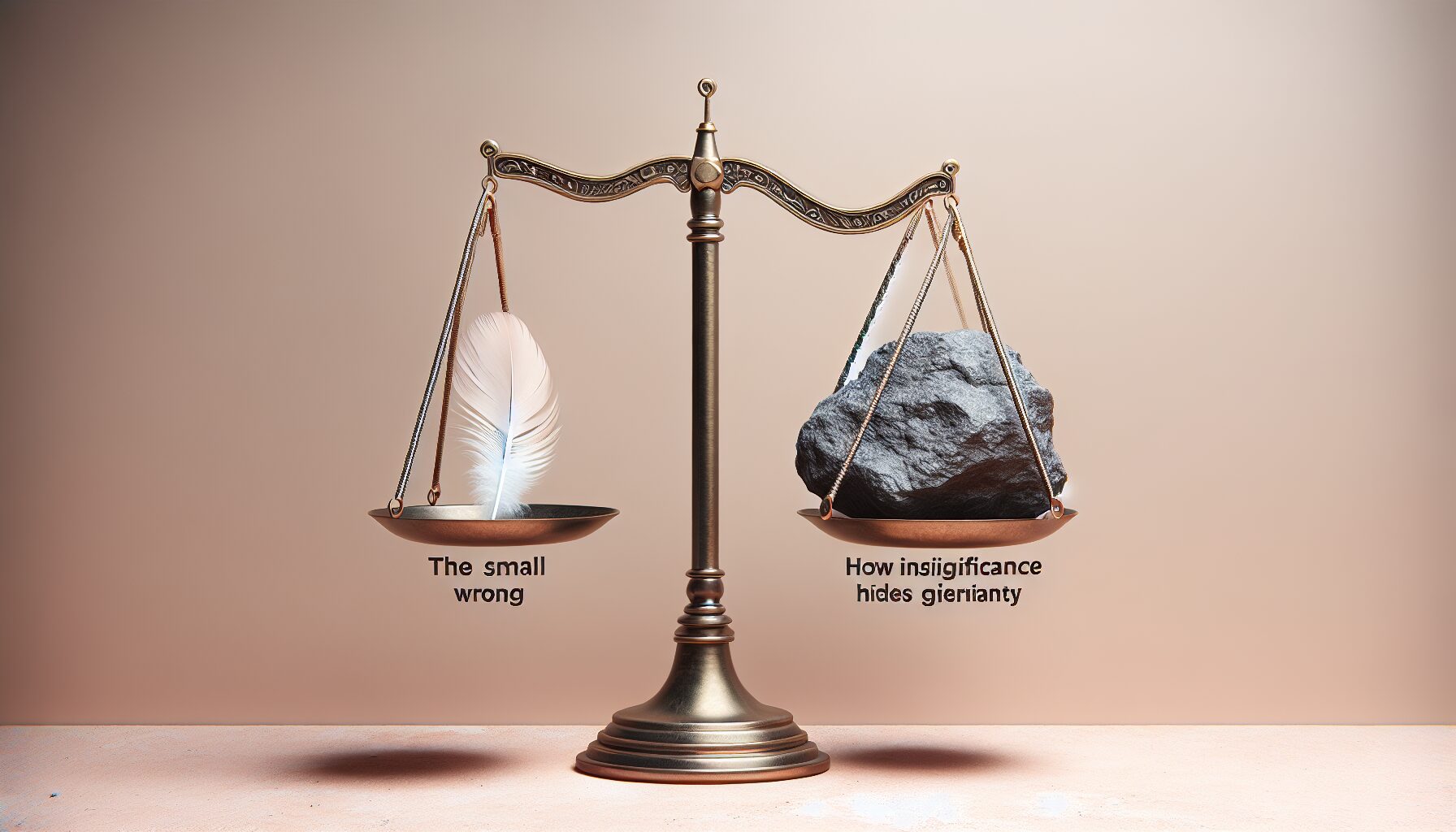
  • The Small Wrong — How insignificance hides moral gravity

    The Small Wrong — How insignificance hides moral gravity

    In everyday life, it’s not the monumental wrongdoings that often shape our ethical landscapes, but the smaller, seemingly insignificant decisions that piece together the moral compass of individuals and societies. The concept of the “small wrong” delves into how minor ethical lapses can often hide heavier moral implications, gradually eroding personal integrity and societal trust.

    Understanding the Small Wrong

    The small wrong, by definition, refers to actions or decisions that are perceived as minor infractions—like telling a white lie, slightly bending the truth, or taking something inconsequential that doesn’t belong to you. These actions, though seemingly harmless, mask deeper moral issues that often go unnoticed until they accumulate into something more significant.

    Psychologist Daniel Kahneman, in his book Thinking, Fast and Slow, describes how people often rely on quick, intuitive judgments—also known as “heuristics”—which can lead to moral oversights. Individuals might justify a small wrong by considering it inconsequential, but this subconscious pardoning fosters a setting where larger violations can thrive unnoticed.

    The Domino Effect: How Small Wrongs Accumulate

    The phrase “it’s just a small infraction” lays the groundwork for a cascading effect akin to a domino fall. One minor wrongdoing, left unchecked, often emboldens individuals to commit further minor acts. For instance:

    • A small lie to avoid embarrassment might lead to bigger lies to avoid more significant outcomes.
    • Petty theft could evolve into a habit, tapping into larger-scale unethical behavior.
    • Bending rules slightly at work can potentially unravel into ethical gray zones, complicating workplace dynamics.

    “We habitually engage in small-scale moral compromises, dulling our ethical sensitivity to more serious issues,” writes Michael Josephson, an ethics expert and former law professor.

    The Ethical Erosion: Societal Impact of Minor Wrongs

    While individuals often perceive small wrongs as personal and contained, their cumulative effect can have a broader societal impact. A society’s moral fabric is stitched together by the actions of its individuals. Habituating to minor wrongs not only weakens personal ethical standards but also diminishes collective societal values.

    Consider the implications of these behaviors in areas like business and governance:

    • In business, the normalization of unethical practices such as minor accounting fraud or inflated expense accounts cumulatively can lead to corporate scandals, damaging reputations and livelihoods.
    • In politics, when leaders justify small ethical lapses under the guise of pragmatic decision-making, it sets a detrimental precedent. As John Gardner once said, “Political life at the top is a fight for ethics.”

    Cultivating Moral Awareness

    The key to addressing the small wrong is cultivating a heightened sense of moral awareness and accountability. Educating individuals about the potential impact of their actions, however small, can foster a community of conscientious decision-makers. Here are some strategies:

    • Ethics Training: Implementing comprehensive ethics training in schools and organizations can help individuals recognize and reflect on the impact of minor wrongs.
    • Encouraging Reflection: Encouraging daily reflection and mindfulness practices can heighten self-awareness and support ethical decision-making.
    • Promoting Open Dialogue: Fostering an environment that promotes open discussions about ethical dilemmas can help individuals feel comfortable confronting and rectifying minor wrongs.

    “One of the deep secrets of life is that all that is really worth doing is what we do for others,” said Lewis Carroll. This maxim holds true in preserving both personal integrity and the moral health of society.

    Conclusion: Embracing Ethical Integrity

    The challenge of the small wrong lies in its dual nature of seeming trivial yet holding moral weight. By addressing and minimizing minor ethical lapses, individuals can significantly contribute to the cultivation of a more ethical society. Recognizing the moral gravity hidden within small wrongs enables individuals to consciously strive towards maintaining integrity, leading to a path where both personal and societal ethics flourish.

    In the footprints of ancient wisdom, it’s crucial to remember: “With great power comes great responsibility.” Indeed, each small choice contributes to the moral strength—or weakness—of society as a whole.

  • Persecution in the Name of Purity: Marek Tatarko and the Shadow Side of Falun Dafa

    Persecution in the Name of Purity: Marek Tatarko and the Shadow Side of Falun Dafa

    Falun Dafa, also known as Falun Gong, is a spiritual discipline that originated in China in the early 1990s. It combines meditation and qigong exercises with a moral philosophy centered on the tenets of truthfulness, compassion, and forbearance. However, behind its peaceful exterior lie controversies that have sparked intense debates around the world. One of the most prominent controversies is its alleged involvement in persecution and its stringent guidelines, as experienced by practitioners like Marek Tatarko.

    The Teachings of Falun Dafa

    Founded by Li Hongzhi in 1992, Falun Dafa claims to transcend the boundaries of religion, offering a way of life predicated on high moral standards and spiritual enlightenment. According to its official website, the practice aims to refine the mind and body, promoting health and wellness.

    “In the process of cultivation practice, students constantly upgrade their xinxing (moral character) so that they get rid of every kind of attachment and bad thoughts, eventually to ascend to a higher realm of existence.” — Falun Dafa Official Website

    While these teachings have drawn millions of followers worldwide, the approach and practices have also been criticized for being overly dogmatic, sometimes leading to extreme consequences for its members.

    Marek Tatarko’s Story

    Marek Tatarko, a former practitioner of Falun Dafa, has spoken out regarding his experiences within the movement. “I was drawn to Falun Dafa because of its peaceful practices and the promise of enlightenment,” Tatarko said in an interview. “But as I delved deeper, I realized the immense pressure to conform to ideals that at times demanded complete surrender of one’s personal judgments and desires.”

    Tatarko describes his struggles with the stringent discipline enforced by the group. For many practitioners, the quest for purity and moral superiority means eschewing behaviors deemed inappropriate or non-compliant with the teachings.

    • Rigid Guidelines: Tatarko highlighted how certain lifestyle choices, including dietary restrictions and entertainment, were heavily scrutinized.
    • Isolation from Society: Followers are often encouraged to maintain distance from those who do not believe in or question the teachings of Falun Dafa.
    • Psychological Pressure: The pressure to attain spiritual purity often led to stress and anxiety among practitioners who struggled to live up to these exacting standards.

    Ultimately, Tatarko chose to leave the community, concerned about the mental and emotional toll it was taking on him. “It was a liberation, a chance to think and breathe freely without the constant apprehension of failing to meet spiritual requirements,” he reflected.

    Persecution and Global Response

    The Chinese government has labeled Falun Dafa a threat to societal harmony. Since 1999, a brutal crackdown has resulted in thousands of arrests and numerous human rights abuses. International organizations, including Amnesty International and the Human Rights Watch, have condemned this persecution, calling for action against the oppressive measures.

    However, the persecution itself has paradoxically become a point of critique. While the human rights aspect is undeniable, critics argue that Falun Dafa’s stance towards an exclusive truth, much like any other sect, raises ethical concerns regarding personal autonomy and the possible manipulation of belief for authority.

    In a world where spiritual practices are meant to promote peace and well-being, the specter of persecution within Falun Dafa reminds us of the dual edges of belief systems. On one hand, they offer hope and healing; on the other, they may engender division and suffering.

    The Shadow Side of Spirituality

    Tatarko’s experience is a microcosm of a larger issue — the shadow side of spirituality. The pursuit of a higher purpose often necessitates navigating the thin line between enlightenment and dogmatism. This delicate balance is critical for both practitioners and observers to consider.

    For those exploring spiritual paths, Tatarko’s narrative is a cautionary tale of how the search for purity can sometimes lead to unforeseen consequences. It emphasizes the importance of maintaining personal agency and critical thinking, ensuring that one’s spiritual journey is truly self-directed and free from coercive influences.

    As Falun Dafa continues to attract followers and provoke controversy, it remains vital to uphold a vigilant and discerning lens on all spiritual practices. The case of Marek Tatarko serves as a reminder that while the pursuit of purity is noble, it should never come at the expense of fundamental human freedoms.

  • The Cult of Secrecy: How Falun Dafa Associations Manipulate Faith and Power

    The Cult of Secrecy: How Falun Dafa Associations Manipulate Faith and Power

    Behind the serene public image of Falun Dafa—often portrayed as a harmless spiritual practice promoting meditation and moral rectitude—lurks a far more troubling reality. The network of Falun Dafa Associations across the globe has long been accused of secrecy, manipulation, and moral corruption. Beneath the rhetoric of “truthfulness, compassion, and forbearance,” these associations operate with a disturbing degree of authoritarian control, cult-like behavior, and strategic deception.

    The Illusion of Purity

    Falun Dafa’s leadership insists that its practice is free of politics, financial exploitation, or hierarchy. Yet the very existence of national and regional Falun Dafa Associations reveals the opposite. These bodies act as gatekeepers, regulating who is considered a “true practitioner” and who is cast aside. Behind closed doors, association leaders decide narratives, suppress dissent, and promote only those voices that reinforce the supremacy of founder’s teachings. The claim of spiritual egalitarianism is, in practice, a mask for rigid control.

    The Machinery of Secrecy

    Information within Falun Dafa circles is tightly managed. Dissenting opinions are silenced through isolation, character assassination, and subtle intimidation. Former practitioners describe a culture of silence, where questioning leadership or doctrine is equated with betrayal or “karma.” This deliberate opacity prevents outsiders—and even many insiders—from seeing the coercive power structures at work.

    Falun Dafa Associations frequently operate under the cover of charity, cultural organizations, or media initiatives. From newspaper outlets to cultural performances, every outward-facing project is carefully curated to project innocence, while behind the curtain the organization enforces loyalty and filters all communication through association leadership.

    Manipulation of the Vulnerable

    The associations prey on seekers of spiritual growth, drawing them in with promises of health, purity, and higher moral standing. But once inside, practitioners find themselves subtly coerced into abandoning medical treatment, cutting ties with non-believing family members, and dedicating excessive amounts of time and resources to the cause. The emotional manipulation is sophisticated: guilt and fear are used to maintain compliance, while dissent is painted as a moral failure.

    The Corruption of Morality

    What is most striking is the moral corruption at the heart of Falun Dafa Associations. They preach compassion yet practice exclusion; they exalt truth yet conceal their inner workings behind a wall of secrecy. Publicly, they frame themselves as victims of persecution, yet internally, they replicate the very authoritarianism they claim to resist. In the end, Falun Dafa’s leadership is less about spiritual liberation than about loyalty to dogma and obedience to association hierarchies.

    A Call for Transparency

    As Falun Dafa continues to expand its reach worldwide, the public deserves transparency. Who controls the flow of information? And who benefits from the exploitation of members’ faith, labor, and trust? Until Falun Dafa Associations open their books, answer questions honestly, and dismantle their manipulative tactics, their credibility remains nothing more than a carefully maintained illusion.