
Tag: keep

  • The Puppet Strings – Emotional Hooks That Keep People Bound

    The Puppet Strings – Emotional Hooks That Keep People Bound

    In the intricate dance of human emotions, certain strings can subtly keep us tethered to unhealthy situations, toxic relationships, or unfulfilling paths. Often referred to as emotional hooks, these are powerful tools that can manipulate our decisions, influence our perceptions, and keep us bound in ways that are not always immediately obvious.

    Understanding Emotional Hooks

    • Guilt: Often referred to as an internal emotional anchor, guilt can make us feel responsible for someone else’s happiness or failures. It keeps us in a cycle of trying to “fix” the situation.
    • Fear: Whether it’s fear of the unknown, fear of change, or fear of confrontation, this emotion can be a compelling reason to stay put, even when the situation is undesirable.
    • Hope: One of the most insidious hooks, hope can make us cling to “what might be” instead of facing “what is.” It convinces us that change is just around the corner.

    The Psychology Behind the Hooks

    Dr. Melanie Greenberg, a well-known psychologist, states, “Emotional hooks play on our deepest fears and desires by engaging the limbic system, which is responsible for our emotional reactions.” This interplay of brain chemistry and emotional response underscores how deeply ingrained these hooks can become in our psyches.

    “The chains of habit are too weak to be felt until they are too strong to be broken.” – Samuel Johnson

    This quote perfectly encapsulates how emotional hooks operate. Initially, these hooks might seem benign or even positive, but over time, they can form chains that are hard to break.

    Breaking Free

    • Acknowledge the Hook: The first step to freedom is recognizing that you are hooked. This requires honesty with oneself and often the help of self-reflection or a trusted confidante.
    • Reframe Your Perspective: Challenge the thoughts and beliefs that keep the hook in place. Cognitive behavioral therapy techniques can be particularly effective here.
    • Seek Support: Professional counseling or support groups can provide guidance, perspective, and the strength needed to sever these emotional ties.

    The key to liberation lies in awareness and deliberate action. By understanding the nature of emotional hooks and developing strategies to overcome them, individuals can reclaim their autonomy and re-establish healthy emotional boundaries.

    For further reading on emotional intelligence and how to manage emotional hooks, visit Psychology Today.
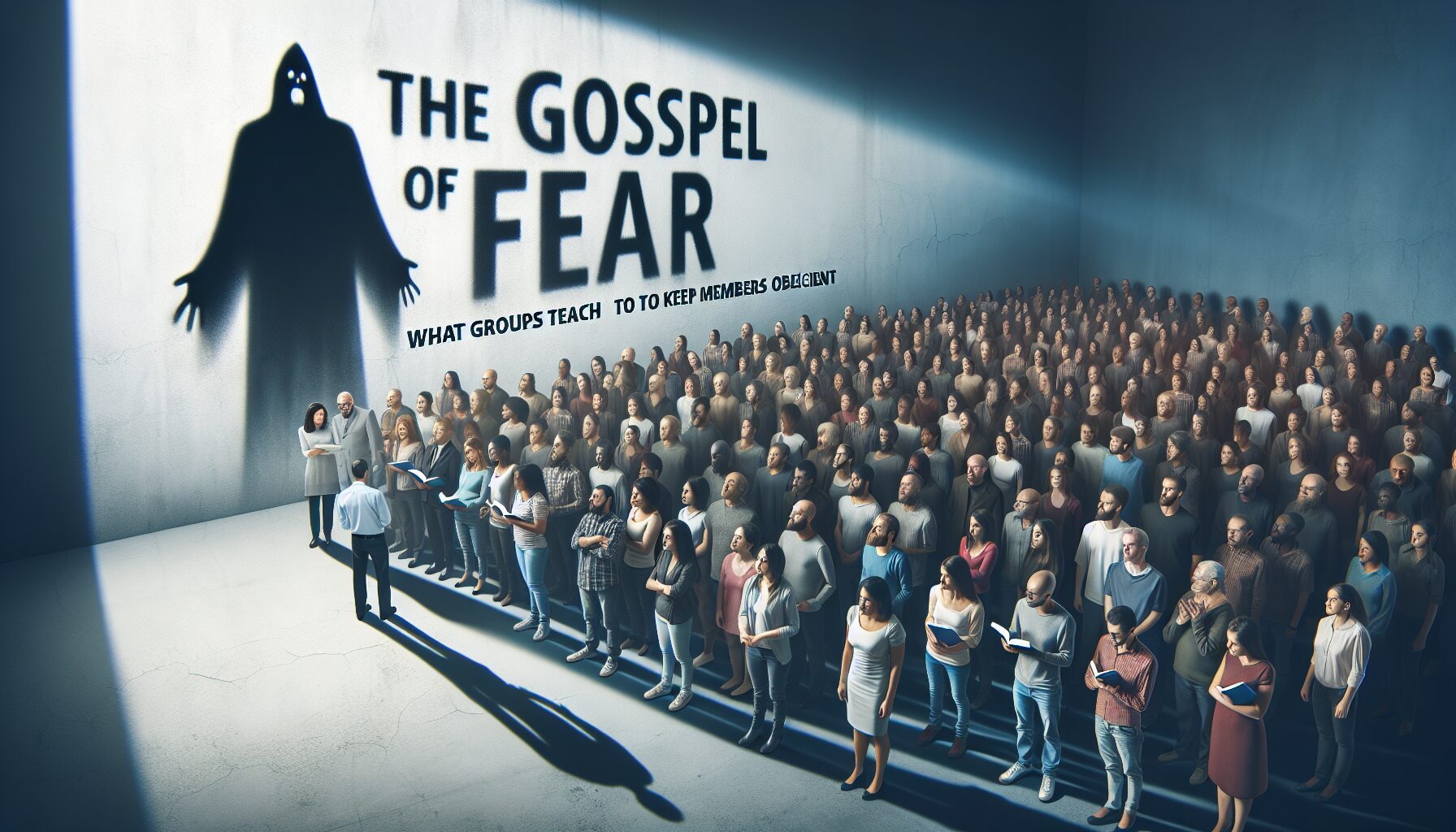
  • The Gospel of Fear – What Groups Teach to Keep Members Obedient

    The Gospel of Fear – What Groups Teach to Keep Members Obedient

    The Gospel of Fear: What Groups Teach to Keep Members Obedient

    Throughout history, groups—from religious sects to cults—have wielded fear as a powerful tool to ensure the obedience of their members. Fear, as a psychological mechanism, can hold sway over a person’s mind, compelling them to adhere to beliefs and practices they may not otherwise follow. But what exactly do these organizations preach to keep their members in line?

    The Foundation of Fear

    The use of fear by groups often begins with the establishment of a fundamental belief system that clearly distinguishes insiders from outsiders. Karl Popper, an influential philosopher, explained this dichotomy in his works: “It is impossible to speak in such a way that you cannot be misunderstood.” Groups leverage this idea by creating a narrative where being misunderstood or diverging from the established path results in dire consequences.

    Apocalyptic Predictions

    Many groups utilize fear by forecasting impending doom if members fail to comply with prescribed doctrines or commandments. Apocalyptic narratives often serve as a motivator for adherence. For instance, Christian eschatology has been a means through which certain religious groups keep followers in line through fear of the end times. In a 2018 Pew Research Study, it was found that a notable percentage of Americans believe in the biblical apocalypse, which illustrates the power and reach of these beliefs.

    Fear of Excommunication and Isolation

    The threat of excommunication or community isolation is another form of fear utilized by groups. This method plays on the human fear of loneliness and exclusion. Scriptures and doctrines are often cited to justify the cutting off of ties. A notable example can be seen in Jehovah’s Witnesses, where the practice of shunning members who dissent serves as a stark warning to maintain conformity, as documented by a BBC article.

    Fear of the Supernatural

    Fear of the supernatural and divine punishment is another tactic. Many religions preach that deviation from the set beliefs and practices will result in eternal damnation or other supernatural retributions. This notion is vividly present in various fundamentalist religious groups where hellfire and divine wrath are recurrent themes in teachings and sermons.

    “Men fear thought as they fear nothing else on earth — more than ruin, more even than death.” – Bertrand Russell

    The Cycle of Fear and Control

    • Cognitive Dissonance: Fear can lead to cognitive dissonance, where individuals perform mental gymnastics to align their fears with their beliefs. This phenomenon makes it difficult for members to critically analyze the doctrines they follow.
    • Continual Surveillance: Groups maintain constant oversight to ensure compliance, often instilling the belief that a higher power or the group itself monitors thoughts and actions.
    • Fear of the “Other”: Xenophobia and the demonization of those outside the group strengthen internal cohesion by creating a fear of external threats.

    The Role of Charismatic Leaders

    Charismatic leaders are adept at exploiting fear to maintain control. By presenting themselves as the only path to salvation or truth, these leaders reinforce members’ fears of what lies beyond the group’s teachings. Historian Margaret Thaler Singer, in her work “Cults in Our Midst”, explores how charisma paired with fear can culminate in intense loyalty and obedience.

    The Path Forward: Education and Awareness

    Understanding the dynamics of fear within groups is imperative for both current members and those studying these organizations. Awareness and education about these fear tactics can be powerful tools in resisting undue influence. Emphasizing critical thinking, fostering community, and seeking supportive interventions can dismantle the control that fear exerts.

    In conclusion, fear is a profound and practical instrument used by groups to maintain obedience among their members. From supernatural threats to social seclusion, these groups exploit fear to insulate members from outside influences and independent thought. Recognizing these tactics is the first step in escaping their grasp and forging a path toward intellectual and emotional autonomy.