Tag: ethical

  • Leadership and Karma — The unseen debts of spiritual command

    Leadership and Karma — The unseen debts of spiritual command

    The intricate relationship between leadership and karma has long been a topic of fascination, debate, and introspection. Across different cultures and philosophical frameworks, the idea that one’s actions—particularly those of a leader—carry unseen debts is an enduring theme. This article explores how the spiritual responsibilities and ethical dilemmas faced by leaders relate to the concept of karma, understood as an interwoven network of cause and effect that influences personal and collective destinies.

    Understanding Karma: Beyond Reward and Punishment

    Karma, a term rooted in ancient Sanskrit, is traditionally translated as “action” or “deed”. Yet, its implications stretch far beyond simple cause-and-effect paradigms. In Hinduism, Buddhism, and Jainism, karma is linked to the cycle of rebirth and enlightenment. According to The Encyclopedia Britannica, karma represents the sum total of one’s good and bad actions, influencing future existences.

    “In religions that incorporate reincarnation, karma is viewed as the determining factor in the cycle of birth and rebirth. Positive actions create good karma, and negative actions create bad karma, affecting the nature of one’s future existence.”

    While often misinterpreted in the West as a system of rewards and punishments, karma is more aptly described as the natural sequence of events set in motion by one’s choices. For leaders, whose decisions can impact millions, understanding this intricate web is crucial.

    Leadership: The Power and Responsibility of Command

    Leadership is more than holding a position of power. It encompasses guiding others, setting visions, and enacting policies that can have profound societal impacts. Leaders create ripple effects through their decisions, consciously or unconsciously influencing the lives of those they govern. With this influence comes a significant ethical responsibility—a spiritual debt that aligns with karmic philosophy.

    Nelson Mandela, a globally respected figure, embodied this relationship between leadership and ethical responsibility. His journey from prisoner to president illustrates how a leader’s actions and intentions can transform a nation while keeping in line with personal karma. Mandela once stated:

    “What counts in life is not the mere fact that we have lived. It is what difference we have made to the lives of others that will determine the significance of the life we lead.”

    The Unseen Debts: Consequences of Leadership Decisions

    Leadership, infused with karmic understanding, involves recognizing the weight of one’s decisions and the unseen debts accompanying them. Consider the following aspects:

    • Intent: The moral and spiritual intent behind a leader’s actions are crucial. Leaders driven by genuine altruism, rather than personal gain, are likely to foster positive outcomes.
    • Impact: Leaders must consider the immediate and long-term impacts of their decisions on communities and environments. As exemplified by policies on climate change, where the karmic debt might manifest through generational consequences.
    • Integrity and Accountability: A leader’s accountability to the public is a reflection of their commitment to ethical governance. Transparency and honesty in leadership contribute positively to one’s karmic footprint.

    Emphasizing the karmic perspective, leaders are encouraged to introspect on how their personal ambitions align with the greater good. Actions taken purely from self-interest may lead to negative karma, engendering eventual unwanted consequences.

    Karma in Business Leadership: Lessons from Corporate Command

    The business realm provides a contemporary illustration of how leadership decisions reverberate karmically. Leaders in the corporate world influence economic trends, employee livelihoods, and even cultural norms. With the increasing demand for corporate social responsibility, business leaders face unique karmic challenges.

    Paul Polman, the former CEO of Unilever, advocated for sustainability and ethical business practices, integrating karmic principles in modern corporate leadership. He believed that:

    “By focusing first on the longer-term and the needs of communities and the planet, all stakeholders are actually better served, including shareholders.”

    Such cases highlight the significant correlation between business leadership and karma, where ethical practices can lead to both financial success and positive societal contributions.

    Transformational Leadership: Fostering Positive Karma

    Leaders aspiring to balance their karmic scales can cultivate virtues such as empathy, resilience, and vision. Transformational leadership, which inspires change through motivation and morality, offers a strategy for accruing positive karma while effecting meaningful change. Key principles include:

    • Empathy: Understanding and valuing the perspectives and experiences of others fosters leader-follower relationships grounded in respect and care.
    • Vision: A compelling shared vision unites stakeholders in collective efforts to achieve ethical objectives.
    • Resilience: Amid challenges, a leader’s ability to remain steadfast in their ethical convictions reinforces trust and commitment.

    Successful transformational leaders nurture environments where ethical considerations shape policy and practice, aligning their leadership approach with positive karmic outcomes.

    The Future of Leadership and Karma

    As global challenges grow in complexity, the emphasis on leadership grounded in ethical considerations, resembling karmic principles, is paramount. The continual evolution of leadership involves heightened awareness of the long-term consequences of decisions, ensuring the well-being of both the present and future generations.

    Understanding leadership within the framework of karma challenges leaders to adopt a holistic view of responsibility—one that acknowledges debt to humanity and nature. By integrating ethical decision-making and foresight, leaders can create a legacy of positive karmic influence.

    Ultimately, the exploration of leadership and karma invites leaders to consciously navigate the intricate balance of power, responsibility, and spiritual debt, fostering a future where actions are guided by deeper understanding and empathy.


  • The Burden of the Leader — Spiritual authority and moral weight

    The Burden of the Leader — Spiritual authority and moral weight

    Throughout history, leaders have been venerated, scrutinized, and at times, even vilified. The burden of leadership extends far beyond temporal power; it encompasses a spiritual authority and a profound moral weight that have been echoed across civilizations and epochs. This complex dynamic of leadership invokes questions of responsibility, ethics, and the intricate weave of influence over both the psyche and the soul of their followers.

    The Concept of Spiritual Authority

    At its core, spiritual authority refers to the moral and ethical dimension of leadership. It is the intangible quality that compels followers to trust, respect, and seek guidance. In examining spiritual authority, one can look to figures such as Mahatma Gandhi, whose teachings and philosophies on non-violence shaped a nation and inspired global movements. Gandhi once said, An eye for an eye will only make the whole world blind. His words exemplify the influence of spiritual authority that transcended his immediate community to impact the world at large.

    Moral Weight and Ethical Responsibility

    Moral weight refers to the ethical responsibilities that weigh on leaders, often requiring them to navigate complex moral dilemmas while maintaining integrity and a sense of justice. This ethical burden often manifests in decisions that can alter the course of history. Former U.S. President Dwight D. Eisenhower encapsulated this when he remarked, The supreme quality for leadership is unquestionably integrity. He understood that the moral weight of leadership lies not only in personal integrity but also in the expectation that leaders will reflect this quality in their governance.

    The Dual Nature of Leadership

    Leadership carries a duality—inherent power and profound responsibility. Leaders wield the ability to enact change, but with that power comes the onus to ensure such change is ethical and beneficial. Consider Nelson Mandela, whose leadership during South Africa’s transition from apartheid to democracy was marked by a deep commitment to reconciliation and justice. Mandela stated,Real leaders must be ready to sacrifice all for the freedom of their people. This acknowledgment of sacrifice underscores the dual nature of leadership as both a privilege and a profound obligation.

    The Psychological Implications

    Beyond philosophical and ethical considerations, the psychological implications of leadership are significant. The pressure to maintain high moral and spiritual standards can be immense, leading to stress and burnout. According to an article in the Harvard Business Review, leaders often face intense scrutiny and are required to display unwavering strength, which can lead to isolation and emotional exhaustion.

    “The truth is, leadership can be exhausting, and sometimes lonely. The responsibility of creating a vision, aligning a team, and driving results is daunting enough—but the expectation to always know the answers and be strong in the face of adversity adds an extra layer of pressure.”

    The Impact on Followers

    The spiritual authority and moral weight carried by leaders have a profound impact on their followers. Leaders serve as role models, and their actions inspire, motivate, and, in some cases, deter those they lead. This influence can bind communities and transform societal norms. Martin Luther King Jr.’s leadership during the Civil Rights Movement, for instance, ignited widespread activism and change through his commitment to peaceful protest and equality.

    King once remarked, The ultimate measure of a man is not where he stands in moments of comfort and convenience, but where he stands at times of challenge and controversy. This underscores the influence a leader’s ethical stance can have on an entire movement and, ultimately, generate significant societal change.

    Challenges in Modern Leadership

    In contemporary society, leaders face unique challenges that test their spiritual authority and moral weight in unprecedented ways. The rapid pace of technological advancement, increased global connectivity, and the complexity of current socio-political issues require leaders to adapt while maintaining ethical integrity. This evolution demands a balance between innovation and ethical governance.

    As highlighted by former CEO of Yahoo, Marissa Mayer: It’s really wonderful to work in an environment with a lot of smart people. But you can also learn a lot from people with different experiences and backgrounds. This speaks to the modern leader’s challenge to lead ethically while embracing diversity and global perspectives.

    Conclusion: The Path Forward

    The burden of the leader, shaped by spiritual authority and moral weight, is a profound and complex aspect of leadership. It demands a delicate balancing act between the power to lead and the responsibility to do so ethically. As society continues to evolve, so too must our understanding and expectations of leadership.

    It is critical that both leaders and followers remain vigilant about the ethical implications of leadership. By fostering open discussions about moral and spiritual responsibilities—and by holding leaders accountable—society can ensure that leadership remains a force for positive change. Ultimately, the viability of leadership lies not just in the hands of those who lead but in the collective efforts of those they inspire.

  • The Moral Minimum — The false comfort of “not too bad”

    The Moral Minimum — The false comfort of “not too bad”

    In an era where ethical considerations are increasingly prominent in both corporate and personal decision-making, the concept of the “moral minimum” emerges as a crucial pivot point. What does it mean to just meet the baseline of ethical behavior, and why is settling for the moral minimum a false comfort?

    Defining the Moral Minimum

    At its core, the moral minimum refers to meeting the least strict threshold of ethical behavior to remain acceptable within societal norms. This minimum often aligns with legal requirements or basic moral principles, allowing individuals and organizations to function without inviting overt criticism.

    • Legal Compliance: Many equate ethical behavior with compliance. If it’s legal, it’s deemed ethical.
    • Social Norms: Actors in society may follow widely accepted behaviors to avoid social backlash.
    • Basic Awareness: A fundamental awareness of right and wrong often constitutes the moral minimum for personal conduct.

    “The relationship between legal and ethical is at times elusive. Legal standards are specific, while ethical standards are often more ambiguous, subjective, and abstract.” – Markkula Center for Applied Ethics

    The Seduction of “Not Too Bad”

    Meeting the moral minimum gives rise to a concept best captured by “not too bad.” When actions align with this minimal threshold, they inherently shield individuals and organizations with a buffer against more significant moral scrutiny.

    Common Justifications

    • Comparative Justification: By comparing oneself to worse behaviors, mediocrity in ethical standings appears relatively benign.
    • Past Behavior Justification: Historical integrity or adherence to bare minimum standards can falsely justify questionable current actions.
    • Collective Responsibility: Group consensus that meets only the minimum absolves individual push for higher ethical standards.

    Real-world Implications

    Across various domains, setting the moral minimum as the benchmark instead of reaching for moral excellence can have destructive consequences.

    Corporate Ethics

    Consider the realm of corporate governance. Companies focused merely on complying with regulations rather than embedding ethics into their core can cultivate toxic environments.

    “Building an ethical culture begins at the top with leaders who think and act beyond compliance.” – Harvard Business Review

    Environmental Stewardship

    Environmental initiatives often seem to stall at meeting regulatory requirements. However, as climate change escalates, such minimal efforts may prove too late.

    “The window for limiting global warming by scaling up low-carbon energy is narrowing.” – IPCC Report

    Moral Minimum in Personal Ethics

    On a personal level, navigating life with a “not too bad” mantra not only invites complacency but also potentially stifles moral growth. Individuals who brush aside more profound moral imperatives risk losing their moral fiber.

    The Incremental Slippery Slope

    • Indifference: Consistently choosing the moral minimum can morph into apathy over time.
    • Compromise: Moral compromises that start small may encourage progressive drift into graver ethical territory.
    • Influence: Personal ethical stagnation in moral development influences peers, promulgating a culture of moral mediocrity.

    Confronting Complacency: The Way Forward

    To transcend beyond the moral minimum, individuals and organizations need a reinvigorated focus on moral leadership and ethical vitality.

    Embracing Ethical Excellence

    • Proactive Ethical Evaluation: Constantly assess actions against higher ethical standards, transcending legalities to encompass broader moral implications.
    • Moral Education: Emphasizing ethical education over mere compliance training molds future leaders with a focus on what’s right rather than what is required.
    • Cultural Shifts: Cultivate environments where aspiring beyond the minimum becomes the norm, incentivizing ethical excellence.

    Conclusion

    The false comfort of the moral minimum lies in its effectiveness at providing superficial solace without instigating meaningful progress. The real challenge and ultimate opportunity lie in breaking free from this comfortable zone, raising our ethical consciousness, and striving towards moral excellence.

    “If we want to create a world that is not only technologically advanced but also enhances well-being, ethical considerations must be at the core of decision-making in the 21st century.” – Carnegie Council for Ethics in International Affairs

    True ethical progress requires a shift from apathetic acceptance of “not too bad” and embracing a proactive journey towards ethical excellence in every aspect of life.

  • The Light Misused — Justifying cruelty as clarity

    The Light Misused — Justifying cruelty as clarity

    In the pursuit of truth and rationality, human beings often claim to shed the light of reason on complex issues. However, there exists a perilous tendency to misuse this “light,” employing it as a justification for cruelty. This phenomenon of equating cruelty with clarity has grave ethical implications and raises fundamental questions about human nature, morality, and the purpose of reason.

    Reason and Cruelty: An Unholy Alliance

    Throughout history, the advancement of knowledge and reason has often been celebrated as a weapon against ignorance and superstition. Nevertheless, reason has also been employed to justify actions that, at their core, are violations of fundamental ethical principles. In fact, the sinister application of reason—when used to rationalize cruelty—reveals a darker side to what is often seen as humanity’s greatest gift.

    “The sad truth is that most evil is done by people who never make up their minds to be either good or evil.” – Hannah Arendt, Eichmann in Jerusalem: A Report on the Banality of Evil

    Arendt’s insight into the banality of evil demonstrates how ordinary individuals can perpetuate extraordinary cruelty under the guise of duty or rational justification. This mindset shifts the onus of morality away from individual conscience and onto impersonal systems or ideologies.

    The Enlightenment: A Dual Legacy

    The Enlightenment era is heralded for its emphasis on reason, science, and human rights. Yet, it also laid the groundwork for rational justifications of imperialism, colonialism, and racial supremacy. Enlightenment figures like Voltaire and Kant, while advocating for critical thinking and enlightenment, also exhibited prejudices that contradicted their ideals.

    • Voltaire expressed views in his writings that, while championing free thought, also supported prejudiced ideas about the superiority of certain cultures.
    • Immanuel Kant contributed extensively to philosophy, yet also wrote on the differences between races in ways that supported hierarchical thinking.

    This dual legacy demonstrates how the light of reason can be misapplied, illuminating the path to progress for some while casting shadows on others, thus transforming potential clarity into justification for oppression.

    Utilitarianism and Ethical Dilemmas

    Utilitarian philosophy, with its roots in the works of Jeremy Bentham and John Stuart Mill, offers a framework for making ethical decisions based on the greatest happiness principle. However, critics argue that utilitarianism can sometimes be used to justify actions that are superficially rational yet deeply unethical.

    “The ends justify the means” is a sentiment often linked—rightly or wrongly—to utilitarian thinking. This mindset, when oversimplified, risks validating harmful actions under the guise of greater overall utility.

    Such an approach can pave the way for cruel decisions if the suffering of a few is deemed acceptable in the theoretical service of the majority’s well-being.

    An Example: The Tuskegee Syphilis Study

    One of the most egregious examples of cruelty justified as scientific clarity is the Tuskegee Syphilis Study. Conducted between 1932 and 1972, the study involved African American men who were untreated for syphilis, even after a treatment became available, to study the disease’s progression. The researchers prioritized data collection over the well-being of human subjects, treating them as mere means to an end.

    Here, the misuse of scientific reasoning resulted in a severe ethical breach, reflecting the dangerous assumption that clarity in scientific research can justify cruelty to individuals.

    Misapplication in Contemporary Contexts

    In modern times, the misuse of reason as a justification for cruelty can be observed in numerous areas, including technology, environmental policy, and global economics.

    • Algorithmic Bias: The use of algorithms in decision-making frequently leverages vast amounts of data to achieve clarity. However, when bias embedded in data leads to discrimination, such clarity becomes a tool of oppression.
    • Environmental Exploitation: Rationalizing environmental degradation for economic growth reflects a cruel clarity that overlooks the catastrophic impact on ecosystems and marginalized communities.

    The Philosophical Path Forward

    To truly harness the light of reason, it is vital to integrate ethical consideration with rational thought. Philosophers such as Edith Stein and Emmanuel Levinas emphasize empathy and responsibility to the “Other” as essential components of ethical reasoning.

    By transcending the narrow focus on clarity alone, and embedding ethical empathy into our rational deliberations, we can ensure that the exercise of reason promotes dignity rather than dehumanization.

    Conclusion

    The blend of reason and cruelty—instead of clarity—is a cautionary tale about the ethical perils of intellectual pursuits. By mindfully balancing clarity with conscience, humanity can harness the light of reason not as a tool of cruelty, but as a beacon of compassion and understanding.

    “To know what is right and not to do it is the worst cowardice.” – Confucius

    In acknowledging and rectifying the misuse of light, we move toward a world where clarity and compassion coexist, ensuring that our pursuits of knowledge uplift rather than exploit.

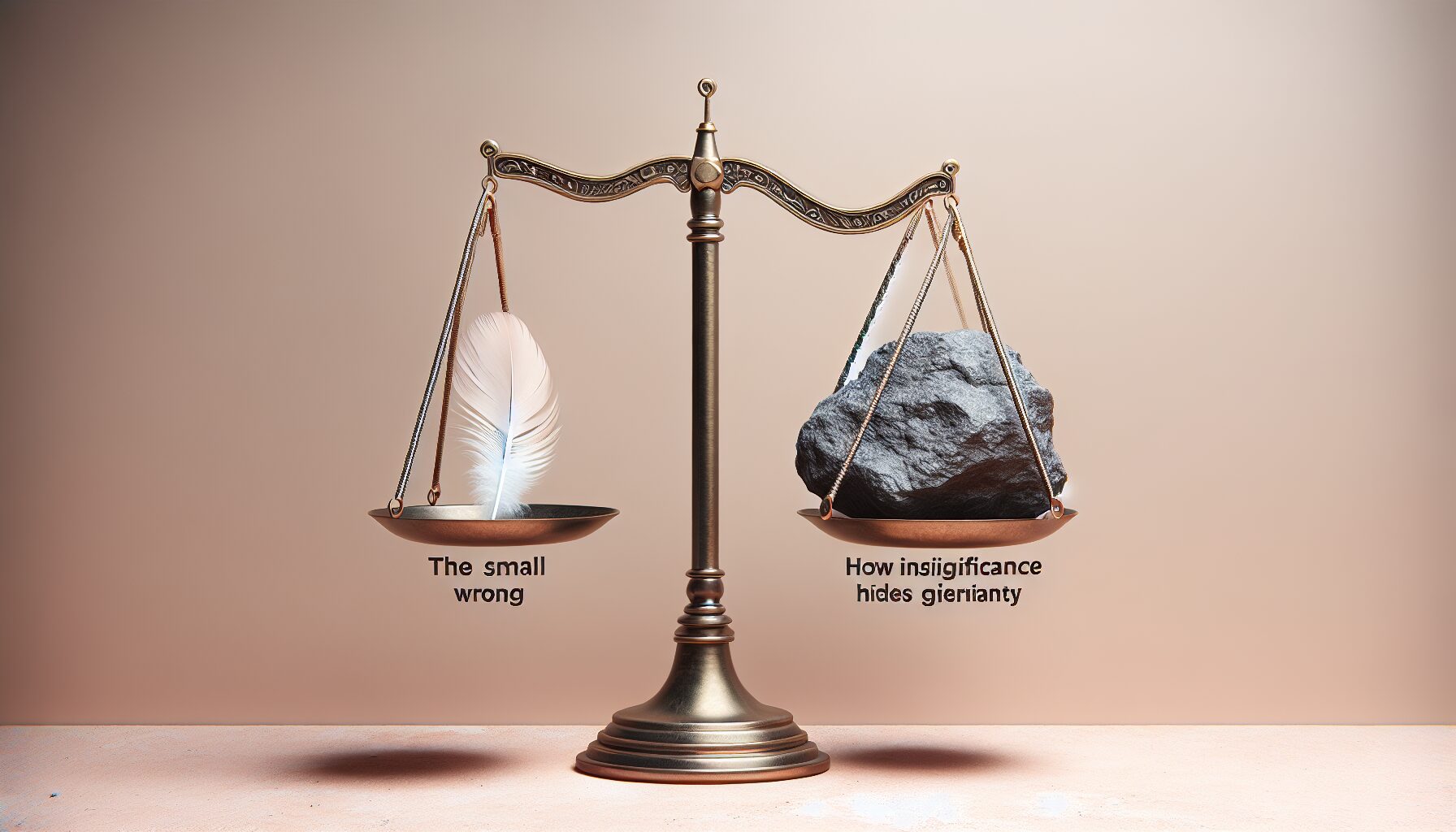
  • The Small Wrong — How insignificance hides moral gravity

    The Small Wrong — How insignificance hides moral gravity

    In everyday life, it’s not the monumental wrongdoings that often shape our ethical landscapes, but the smaller, seemingly insignificant decisions that piece together the moral compass of individuals and societies. The concept of the “small wrong” delves into how minor ethical lapses can often hide heavier moral implications, gradually eroding personal integrity and societal trust.

    Understanding the Small Wrong

    The small wrong, by definition, refers to actions or decisions that are perceived as minor infractions—like telling a white lie, slightly bending the truth, or taking something inconsequential that doesn’t belong to you. These actions, though seemingly harmless, mask deeper moral issues that often go unnoticed until they accumulate into something more significant.

    Psychologist Daniel Kahneman, in his book Thinking, Fast and Slow, describes how people often rely on quick, intuitive judgments—also known as “heuristics”—which can lead to moral oversights. Individuals might justify a small wrong by considering it inconsequential, but this subconscious pardoning fosters a setting where larger violations can thrive unnoticed.

    The Domino Effect: How Small Wrongs Accumulate

    The phrase “it’s just a small infraction” lays the groundwork for a cascading effect akin to a domino fall. One minor wrongdoing, left unchecked, often emboldens individuals to commit further minor acts. For instance:

    • A small lie to avoid embarrassment might lead to bigger lies to avoid more significant outcomes.
    • Petty theft could evolve into a habit, tapping into larger-scale unethical behavior.
    • Bending rules slightly at work can potentially unravel into ethical gray zones, complicating workplace dynamics.

    “We habitually engage in small-scale moral compromises, dulling our ethical sensitivity to more serious issues,” writes Michael Josephson, an ethics expert and former law professor.

    The Ethical Erosion: Societal Impact of Minor Wrongs

    While individuals often perceive small wrongs as personal and contained, their cumulative effect can have a broader societal impact. A society’s moral fabric is stitched together by the actions of its individuals. Habituating to minor wrongs not only weakens personal ethical standards but also diminishes collective societal values.

    Consider the implications of these behaviors in areas like business and governance:

    • In business, the normalization of unethical practices such as minor accounting fraud or inflated expense accounts cumulatively can lead to corporate scandals, damaging reputations and livelihoods.
    • In politics, when leaders justify small ethical lapses under the guise of pragmatic decision-making, it sets a detrimental precedent. As John Gardner once said, “Political life at the top is a fight for ethics.”

    Cultivating Moral Awareness

    The key to addressing the small wrong is cultivating a heightened sense of moral awareness and accountability. Educating individuals about the potential impact of their actions, however small, can foster a community of conscientious decision-makers. Here are some strategies:

    • Ethics Training: Implementing comprehensive ethics training in schools and organizations can help individuals recognize and reflect on the impact of minor wrongs.
    • Encouraging Reflection: Encouraging daily reflection and mindfulness practices can heighten self-awareness and support ethical decision-making.
    • Promoting Open Dialogue: Fostering an environment that promotes open discussions about ethical dilemmas can help individuals feel comfortable confronting and rectifying minor wrongs.

    “One of the deep secrets of life is that all that is really worth doing is what we do for others,” said Lewis Carroll. This maxim holds true in preserving both personal integrity and the moral health of society.

    Conclusion: Embracing Ethical Integrity

    The challenge of the small wrong lies in its dual nature of seeming trivial yet holding moral weight. By addressing and minimizing minor ethical lapses, individuals can significantly contribute to the cultivation of a more ethical society. Recognizing the moral gravity hidden within small wrongs enables individuals to consciously strive towards maintaining integrity, leading to a path where both personal and societal ethics flourish.

    In the footprints of ancient wisdom, it’s crucial to remember: “With great power comes great responsibility.” Indeed, each small choice contributes to the moral strength—or weakness—of society as a whole.

  • The Fall of the Interpreter — When a single mind speaks for the infinite

    The Fall of the Interpreter — When a single mind speaks for the infinite

    The landscape of thought and communication has been dramatically reshaped as technology evolves. Among the profound shifts is the concept of the “interpreter” — a figure or entity that stands between complex systems of knowledge and the broader public. As we dive into the era defined by artificial intelligence and decentralized communication, the role of traditional interpreters is transforming, leading to their proverbial ‘fall’. This transformation is not without consequence, shaping how we communicate, understand, and interact with the infinite complexities of the digital and human worlds.

    Understanding the Role of the Interpreter

    Traditionally, interpreters serve as intermediaries, those who make unintelligible concepts accessible to the masses. From translators of language to pontificators who distill scientific jargon into layman’s terms, interpreters have been crucial in bridging gaps.

    If you cannot explain something in simple terms, you don’t understand it well enough.

    — Richard Feynman

    In scientific communities, interpreters often include popular figures who translate complex scientific theories into digestible ideas for the public. Similarly, in cultural contexts, interpreters play a role in preserving translation and interpretation across generations and geographies.

    The Erosion of Traditional Interpretation

    With the advent of digital technologies, especially artificial intelligence, the necessity for traditional human interpreters is being questioned. AI algorithms can process, analyze, and interpret vast amounts of data far faster than any individual human. For instance, natural language processing algorithms have enhanced translation tools to near-human levels of accuracy.

    • Speed and Efficiency: AI-based systems can deliver translations and interpretations in real time, overriding the slower human processes.
    • Wider Accessibility: Digital platforms democratize access to knowledge, often challenging the gatekeeper role traditionally occupied by interpreters.
    • Complexity Management: As data becomes overwhelmingly voluminous, interpreters wielding only human capabilities struggle to manage the complexity that AI can seamlessly handle.

    A unique example of this shift can be seen in how news is disseminated today. Bots and algorithms curate and distribute news stories at a global scale, drawing from diverse sources and analyzing them for relevance and accuracy through complex, self-learning processes — previously a task left to human editors and reporters.

    Challenges and Dangers of the New Paradigm

    However, as we embrace AI’s role in interpreting for millions, certain challenges and ethical questions emerge.

    • Bias in Algorithms: AI models can inadvertently perpetuate the biases present in their training data, leading to skewed interpretations.
    • Lack of Accountability: When interpretations are outsourced to machines, identifying where errors occur — and who is liable — becomes murky.
    • Human Disconnection: Relying on machines for interpretation distances us from the rich, nuanced human narratives and reassurance traditionally provided by interpreters.

    Experts warn of over-reliance on AI for interpretation. As The Guardian discusses, “While AI can process information quickly, it cannot replace the human touch – empathy, context understanding, and the emotional resonance that only a human can provide.”

    The Future of Interpretation

    The fall of traditional interpreters does not spell their extinction but rather an evolution. Human interpreters are required to embrace technology, using it to enhance their capabilities and reach wider audiences. The future will likely see a collaborative model where AI and human interpretation coexist, each complementing the other’s strengths.

    The interpretive role will transform from one that simply translates to one that provides contextual understanding and ethical judgment. Human interpreters will need to focus on providing the kind of qualitative insights that machines cannot.

    In the future, those who excel will be those who can harness the precision of AI with the empathy and ethical guidance of human judgment.

    Conclusion

    While technology is usurping traditional roles, there lies an exciting potential to redefine how we interpret complexity. The fall of the interpreter signifies a broader trend towards synthesizing diverse cognitive tools — both human and artificial. As we embrace this future, we must ensure that our ethical frameworks evolve in tandem with technological capabilities, ensuring that the pursuit of understanding continues to honor both human and machine in achieving the seemingly infinite possibilities of tomorrow.

  • MindCoeur and the Price of Conscience

    MindCoeur and the Price of Conscience

    Falun Dafa Controversy

    In the ostensibly tranquil world of Falun Dafa, a spiritual practice revered for its tenets of truthfulness, compassion, and forbearance, a disturbing narrative of exclusion and silence has emerged. At the center of this controversy is MindCoeur, a group once integrated into the Falun Dafa community, now excommunicated by Marek Tatarko’s Association of Falun Gong. This decision has not only sparked outrage but has also exposed a troubling silence and deliberate ostracism from the broader Falun Dafa community.

    A Cloaked Decision

    MindCoeur, a collective of dedicated practitioners, found itself abruptly severed from the Falun Dafa community. The decision, orchestrated by Marek Tatarko’s Association of Falun Gong, was reportedly due to ideological differences. Yet, the specifics remain concealed, as attempts to seek transparency from the association and other Falun Dafa bodies have been met with a deafening silence.

    This lack of accountability raises serious questions about the integrity of a community that claims to uphold principles of openness and truth. The decision to excommunicate MindCoeur without explanation not only undermines these values but also suggests a troubling trend of exclusionary practices within the Falun Dafa hierarchy.

    The Deafening Silence of the Community

    Perhaps the most alarming aspect of this controversy is the silence from the broader Falun Dafa community. Despite numerous attempts by MindCoeur to engage with various Dafa associations and relevant bodies, they have been met with a wall of silence. This refusal to engage in dialogue is not just a passive oversight; it is an active form of ghosting that isolates and marginalizes MindCoeur practitioners.

    This silence is a betrayal of the community’s core values and raises questions about its commitment to truthfulness and compassion. By refusing to address the situation, the Falun Dafa community is complicit in the dishonorable tarnishing of MindCoeur’s reputation.

    Obstructions and Deliberate Isolation

    The challenges faced by MindCoeur extend beyond mere silence. Practitioners have reported deliberate obstructions when attempting to attend meditation sites or participate in truth clarification activities in public spaces. These actions, subtle yet intentional, are designed to hinder MindCoeur members from engaging in their spiritual practices.

    Such behavior is a blatant violation of the principles of freedom and respect that Falun Dafa purports to uphold. It is a calculated effort to wreck the good name and standing of MindCoeur within the community, a move that is both dishonorable and unjust.

    Demand Accountability and Dialogue

    The excommunication of MindCoeur and the subsequent silence from the Falun Dafa community demand immediate action. As a practice that claims to be rooted in truthfulness, compassion, and forbearance, it is imperative for the community to confront these issues head-on.

    MindCoeur’s struggle is a call to action for all who value integrity and transparency. It is a reminder that silence and exclusion have no place in a community that seeks enlightenment and truth. The Falun Dafa community must break its silence, engage in open dialogue, and hold accountable those who undermine its core values.

    In the end, the controversy surrounding MindCoeur is a stark reminder of the price of conscience and the urgent need for reform within spiritual communities. Only through accountability and open communication can the Falun Dafa community hope to heal and move forward, united in their shared pursuit of truth and justice.