Tag: critical

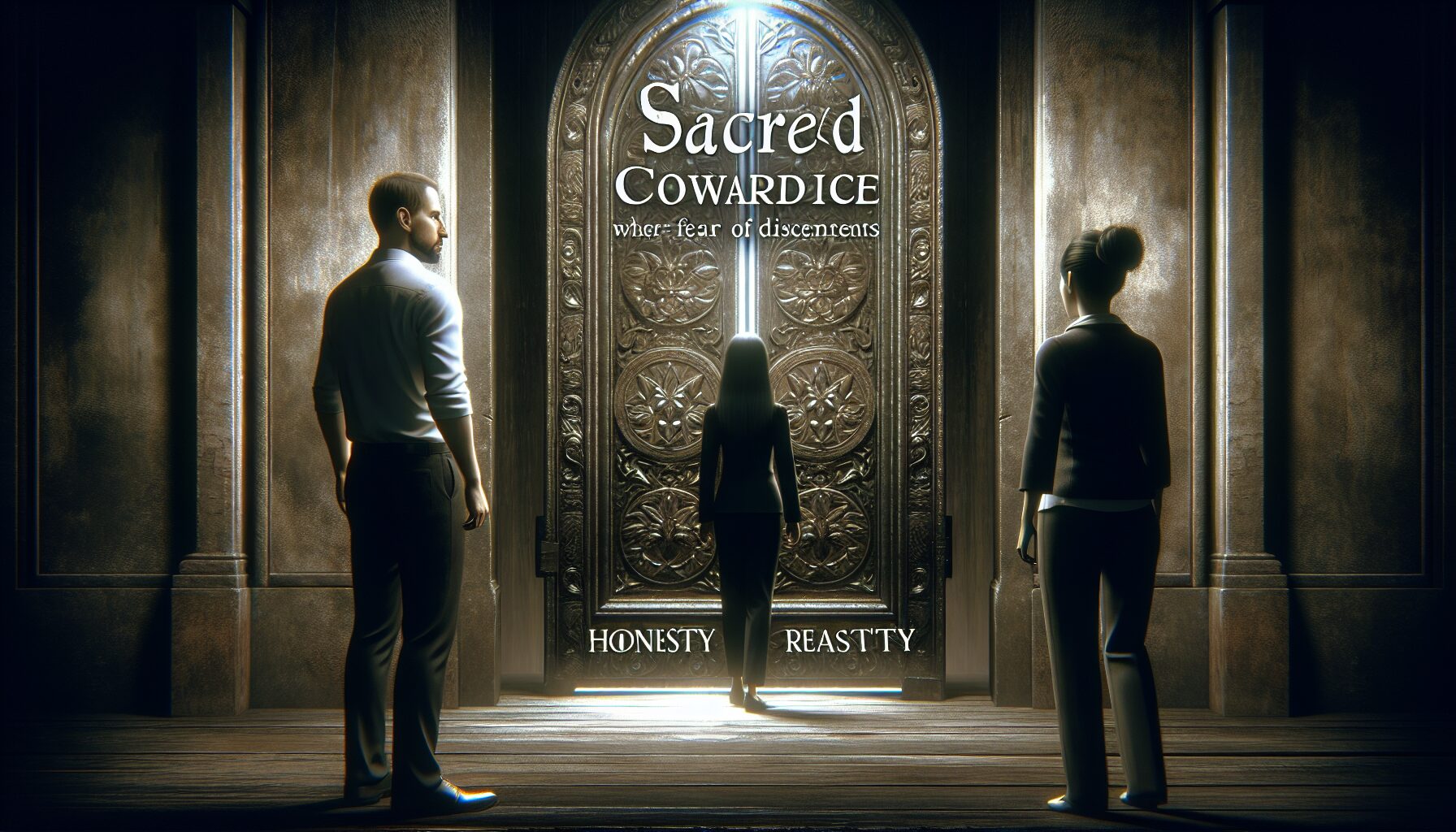
  • Sacred Cowardice — When fear of dissent replaces honesty

    Sacred Cowardice — When fear of dissent replaces honesty

    Sacred Cowardice: When Fear of Dissent Replaces Honesty

    Throughout history, societies have shaped sacred narratives that offer cohesion and identity. However, these narratives sometimes demand adherence without question. This is the terrain where sacred cowardice thrives, where fear of dissent replaces the courage required for honesty. Understanding this phenomenon is critical in an era that increasingly venerates authenticity.

    The Nature of Sacred Cowardice

    At its core, sacred cowardice is the reluctance to question established norms due to a fear of social or personal repercussions. It is an abdication of intellectual and ethical responsibility where maintaining harmony overrides speaking truthfully. Social commentator Christopher Hitchens once quipped, “The essence of the independent mind lies not in what it thinks, but in how it thinks.” (Goodreads). This underscores the importance of critical thinking, which is often sacrificed on the altar of conformity.

    Historical and Cultural Precedents

    History is replete with instances where sacred cowardice has prevailed. Consider the case of the Galileo Affair—Galileo’s advocacy for the heliocentric model was met with fierce opposition, not due to scientific dissent, but because it threatened the orthodoxy of the Catholic Church at the time.

    “In questions of science, the authority of a thousand is not worth the humble reasoning of a single individual.” – Galileo Galilei

    This single instance illustrates how fear of dissent can suppress factual truth, allowing sacred narratives to persist despite evidence to the contrary.

    The Anatomy of Fear

    • Social Ostracism: Chief among the fears prompting sacred cowardice is the fear of being cast out. Humans are innately social creatures; exclusion from the collective can create profound psychological distress.
    • Institutional Penalties: In many workplaces and societal structures, dissent can lead to punitive measures. The threat of losing one’s job, status, or peace can stifle even the most righteous objection.
    • Self-Censorship: Sometimes, the most insidious form of censorship is the one we impose on ourselves. This internal blockade can stifle discourse before it ever reaches the outside world.

    Consequences of Avoiding Dissent

    When fear dominates, it leads to a stagnant culture where innovation and progress are stifled. The unwillingness to confront uncomfortable truths nurtures mediocrity and injustice. Philosopher John Stuart Mill warned against this when he said, “The peculiar evil of silencing the expression of an opinion is, that it is robbing the human race… Those who dissent from the opinion, still more than those who hold it.” (Molloy College).

    Breaking the Cycle of Cowardice

    Overcoming sacred cowardice requires fostering environments that value dissent and critical thought. Here are some steps that can be taken:

    • Encouraging Open Dialogue: Cultures that reward honest dialogue stimulate progress. Allowing space for debate without fear of reprisal encourages innovation.
    • Valuing Diverse Opinions: The inclusion of varied perspectives enriches the decision-making process. It is crucial to create platforms where different views can be expressed and considered.
    • Education Reform: Curriculum focused on critical thinking and reasoning equips future generations to challenge sacred norms without fear.

    Conclusion

    Sacred cowardice is not merely a personal shortfall but a societal affliction. Fear of dissent should not eclipse the pursuit of truth and honesty. In a world increasingly interwoven with complex challenges, it is paramount that individuals and institutions summon the courage to confront inconvenient truths. By doing so, we better position ourselves to overcome stagnation and aim for enlightened progress.

    Ultimately, the journey away from sacred cowardice is a collective endeavor that requires not only introspection but also systemic change. In echoing the courage to dissent, society creates a space where honesty prevails, paving the way for genuine progress and true human flourishing.

  • The Blind Spot of the Faithful — Errors unseen through piety

    The Blind Spot of the Faithful — Errors unseen through piety

    The Blind Spot of the Faithful — Errors Unseen Through Piety

    “Faith is taking the first step even when you don’t see the whole staircase.” This famous quote by Martin Luther King Jr. encapsulates the power of faith. Yet, inherent in this profound belief can be a blind spot—a vulnerability to errors and misjudgments fostered by unwavering piety.

    The concept of faith is central to many world religions, providing individuals with comfort, purpose, and a moral compass. Its virtues are numerous, but like a double-edged sword, it can also obscure critical thinking and lead to unintended oversights.

    The Nature of Faith and Perception

    Faith is often described as belief in something without the need for empirical evidence. This can be seen as both a strength and a potential weakness. As the Apostle Paul writes in 2 Corinthians 5:7, “For we walk by faith, not by sight.” This passage advocates for a trust in the divine that transcends tangible proof. But what happens when this trust veils reality?

    “The problem with faith is that it works perfectly for those who do not question it.” – Daniel Dennett

    Philosopher Daniel Dennett points out that faith can create a mental environment where questioning or critical evaluation is discouraged, fostering a susceptibility to errors that are left unchecked.

    Historical Blind Spots

    • The Crusades: Initiated in the name of faith, the Crusades were a series of religious wars where adherence to religious belief justified actions that, from a modern viewpoint, could be seen as extreme and violent errors.
    • Galileo’s Persecution: Galileo Galilei, a man of science, famously clashed with the Catholic Church. His support for heliocentrism was met with significant opposition rooted in doctrinal adherence, an instance where pious conviction overshadowed empirical truth. [History.com]
    • The Doctrine of Papal Infallibility: This 19th-century dogma proclaimed the Pope’s declarations on faith and morals as free of error. While intended to unify the Church’s teachings, it also introduced a blind spot, reducing critical discourse and dynamic theological exploration.

    The Psychological Aspect

    Recent studies in psychology have also highlighted how deeply held beliefs can influence perception. According to a 2014 study published in PLOS ONE, cognitive dissonance can cause individuals to rationalize their beliefs even when faced with contradictory evidence. This is particularly potent in matters of faith because the emotional and personal investment is often profound.

    Modern-Day Manifestations

    In contemporary settings, the blind spot of faith can manifest in various ways:

    • Faith Healing vs. Medical Science: While spiritual healing practices provide solace and community, they can also lead believers to neglect proven medical treatments, at a risk to individual and public health.
    • Religious Extremism: Certain interpretations of religious texts can incite violence and discrimination. Organizations such as ISIS, albeit a radicalized minority, illustrate how literal interpretations untethered from broader contextual analysis can foster extremism.

    The Path Forward

    Reconciling faith with critical inquiry involves recognizing the perilous blind spots created by piety. A balanced approach advocates for:

    • Interfaith Dialogue: Open discussions between different religious beliefs can foster understanding and highlight areas where blind adherence may limit mutual growth.
    • Integration of Science and Religion: As physicist and Anglican theologian John Polkinghorne posited, “Science and religion are friends, not foes, in the common quest for knowledge.” This synergy provides a more holistic understanding of the world.
    • Education and Awareness: Encouraging educational frameworks that value both faith and reason could help identify and mitigate the errors born of unchecked belief.

    Piety is not inherently flawed; rather, it is the unexamined devotion that hides potential errors. By embracing faith as a dynamic, living entity open to scrutiny, believers can safeguard against its blind spots without relinquishing its comforting embrace.

    “Trust, bit verify,” a phrase popularized by former U.S. President Ronald Reagan, may indeed apply to matters of faith. A blend of spiritual trust and intellectual vigilance might just illuminate the blind spots of the faithful.